Which type of selection leads to increased phenotypic and genetic variation?
Disruptive selection leads to increased phenotypic and genetic variation by favoring extreme traits over intermediate ones.
Which is the best definition of directional selection?
Directional selection is a type of natural selection that favors one extreme phenotype over others, causing a shift in the population's trait distribution.
Which best describes derived characteristics?
Derived characteristics are traits that are present in an organism but were absent in the last common ancestor of the group being considered.
What adaptation does the organism have that makes it well suited for its environment?
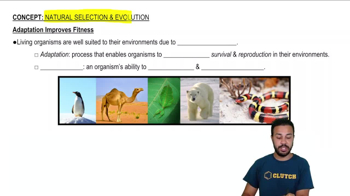
Adaptations are traits that improve an organism's ability to survive and reproduce in its environment, such as camouflage or specialized feeding structures.
What are analogous structures?
Analogous structures are body parts in different species that have similar functions but evolved independently, not from a common ancestor.
What is an analogous structure?
An analogous structure is a feature in different species that performs a similar function but is not derived from a common ancestral structure.
What situation leads to natural selection?
There is variation in traits that affect survival and reproduction.
How does selection favor calling? How does selection favor not calling?
Selection favors calling if it increases mating success, but not calling may be favored if it reduces predation risk.
How does competition for resources lead to adaptations?
Competition for resources leads to adaptations by favoring traits that improve an organism's ability to acquire resources, survive, and reproduce.
How is fitness determined in the biological sense?
Fitness is determined by an organism's ability to survive and reproduce, passing on its genes to the next generation.
How is natural selection in the evolution of long necks in giraffes best explained?
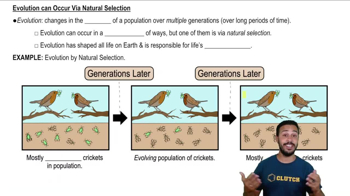
Natural selection favored giraffes with longer necks because they could access food in taller trees, increasing their survival and reproduction.
How do peppered moths avoid predators?
Peppered moths avoid predators by using camouflage to blend into their environment, making them less visible to predators.
Why are some mice light colored and some mice dark colored?
Some mice are light colored and some are dark colored due to genetic variation and natural selection favoring different colors in different environments.
Competition is central to the theory of natural selection. Why does competition occur?
Competition occurs because resources such as food, mates, and habitat are limited, leading organisms to compete for survival and reproduction.
Why are advantageous traits more likely to be passed onto offspring?
Advantageous traits are more likely to be passed onto offspring because they increase an organism's fitness, leading to greater reproductive success.
What makes some individuals more likely to survive and have offspring?
Individuals with traits that enhance their ability to survive and reproduce in their environment are more likely to have offspring.
What observations did Charles Darwin make about finches in the Galápagos Islands?
Darwin observed that finches on different islands had different beak shapes, adapted to their specific food sources.
Which condition is essential for natural selection to result in a new species?
Reproductive isolation is essential for natural selection to result in a new species, preventing gene flow between populations.
At which level does natural selection tend to act?
Population
Are similarities between sharks and dolphins homologous or analogous?
The similarities between sharks and dolphins are analogous, as they evolved independently in response to similar environmental pressures.
What theory did Charles Darwin propose?
He proposed the theory of natural selection.
How do this male peacock’s feathers increase his fitness?
The male peacock's feathers increase his fitness by attracting females, thereby increasing his chances of mating and passing on his genes.
What are analogous structures?
Analogous structures are features in different species that perform similar functions but evolved independently, not from a common ancestor.
What is an example of a vestigial structure?
Human appendix
What is an example of aposematic coloration?
A brightly colored poison dart frog
Why have lions adapted to have sharper teeth than cows?
Lions have adapted to have sharper teeth for hunting and consuming meat, while cows have flat teeth for grinding plant material.
In stabilizing selection, what happens to the population's traits?
In stabilizing selection, intermediate traits are favored, reducing variation and maintaining the status quo in the population.
Natural selection is capable of creating changes in what over generations?
Populations
Which characteristic evolved independently in mammals and birds?
Wings
Where can evolution be directly observed?
In laboratory settings
Which evolutionary event is considered a random change?
Genetic drift
What is an example of directional selection?
Antibiotic resistance in bacteria
What is a derived trait?
A derived trait is a characteristic that is present in an organism but was absent in the last common ancestor of the group being considered.
How does natural selection affect a population?
Natural selection increases the frequency of advantageous traits in a population, leading to adaptation over time.
What is an example of Batesian mimicry?
A harmless snake mimicking a venomous snake
In what ways have modern horses changed from their previous ancestors?
Modern horses have evolved larger body sizes, longer legs, and more complex teeth adapted for grazing.
What are adaptations to an herbivorous diet?
Both flat molars and a long digestive tract
What is directional selection?
Directional selection is a type of natural selection that favors one extreme phenotype over others, causing a shift in the population's trait distribution.
 Back
Back

 07:48
07:48