Skip to main content
General Biology
My Course
Learn
Exam Prep
AI Tutor
Study Guides
Textbook Solutions
Flashcards
Explore
Try the app
My Course
Learn
Exam Prep
AI Tutor
Study Guides
Textbook Solutions
Flashcards
Explore
Try the app
Back
Neurons and Action Potentials exam
You can tap to flip the card.
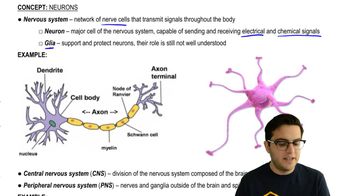
Neuron
You can tap to flip the card.
👆
Neuron
A nerve cell that transmits electrical and chemical signals in the nervous system.
Track progress
Control buttons has been changed to "navigation" mode.
1/30
Related flashcards
Related practice
Recommended videos
Neurons and Action Potentials definitions
Neurons and Action Potentials
8 Terms
Neurons and Action Potentials quiz #1
Neurons and Action Potentials
19 Terms
Neurons and Action Potentials quiz #1
Neurons and Action Potentials
40 Terms
Neurons and Action Potentials
45. Nervous System
7 problems
Topic
Jason
Central and Peripheral Nervous System
45. Nervous System
7 problems
Topic
Jason
45. Nervous System
2 topics
6 problems
Chapter
Jason
12:47
Neurotransmitters
2845
views
21
rank
02:14
Nervous System
4904
views
78
rank
05:33
Postsynaptic Potentials and Summation
3581
views
17
rank
Terms in this set (30)
Hide definitions
Neuron
A nerve cell that transmits electrical and chemical signals in the nervous system.
What is the role of glial cells?
Glial cells support and protect neurons.
Axon
A long projection of a neuron that transmits electrical signals to the terminal.
What is the function of dendrites?
Dendrites receive signals from other neurons.
Action Potential
A rapid rise and fall in membrane potential that propagates along the axon.
What is the role of myelin sheaths?
Myelin sheaths insulate axons and speed up action potential propagation.
Nodes of Ranvier
Gaps in the myelin sheath where ion channels are concentrated.
What is a synapse?
A junction between two neurons where signals are transmitted.
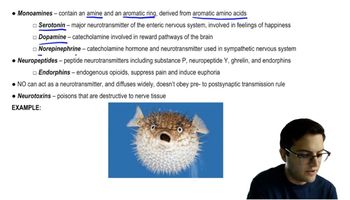
Neurotransmitter
Chemical messengers that transmit signals across a synapse.
What is acetylcholine?
A neurotransmitter involved in muscle contraction and other functions.
GABA
Gamma-aminobutyric acid, the main inhibitory neurotransmitter in the CNS.
What is depolarization?
A decrease in membrane potential, making the inside of the cell less negative.
Repolarization
The process of restoring the resting membrane potential after depolarization.
What is hyperpolarization?
An increase in membrane potential, making the inside of the cell more negative.
Central Nervous System (CNS)
Comprises the brain and spinal cord.
What is the peripheral nervous system?
The part of the nervous system outside the brain and spinal cord.
Sensory Neurons
Neurons that transmit sensory information to the CNS.
What are motor neurons?
Neurons that transmit signals from the CNS to muscles and glands.
Interneurons
Neurons that transmit signals between other neurons.
What is the resting membrane potential?
The baseline membrane potential of a cell, typically negative.
Voltage-Gated Ion Channels
Ion channels that open or close in response to changes in membrane potential.
What are ligand-gated ion channels?
Ion channels that open in response to the binding of a chemical messenger.
Sodium-Potassium Pump
A pump that uses ATP to move sodium out of the cell and potassium into the cell.
What is an equilibrium potential?
The membrane potential at which there is no net movement of a specific ion.
Saltatory Conduction
The process by which action potentials jump from one node of Ranvier to the next.
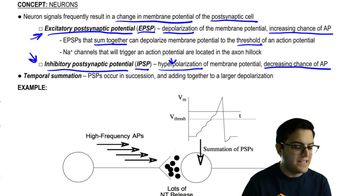
What is an excitatory postsynaptic potential (EPSP)?
A depolarization of the postsynaptic membrane that increases the likelihood of an action potential.
Inhibitory Postsynaptic Potential (IPSP)
A hyperpolarization of the postsynaptic membrane that decreases the likelihood of an action potential.
What is temporal summation?
The process by which multiple postsynaptic potentials occurring in quick succession add together.
Spatial Summation
The process by which multiple postsynaptic potentials occurring simultaneously at different locations add together.
What is the role of calcium ions in neurotransmitter release?
Calcium ions trigger the fusion of synaptic vesicles with the presynaptic membrane, releasing neurotransmitters.
 BackBack
 12:47
12:47