Skip to main content
General Biology
My Course
Learn
Exam Prep
AI Tutor
Study Guides
Textbook Solutions
Flashcards
Explore
Try the app
My Course
Learn
Exam Prep
AI Tutor
Study Guides
Textbook Solutions
Flashcards
Explore
Try the app
Back
Other Species Concepts exam
You can tap to flip the card.
Biological Species Concept
You can tap to flip the card.
👆
Biological Species Concept
Defines species based on reproductive isolation.
Track progress
Control buttons has been changed to "navigation" mode.
1/28
Related flashcards
Related practice
Recommended videos
Other Species Concepts definitions
Other Species Concepts
14 Terms
Other Species Concepts quiz
Other Species Concepts
15 Terms
Other Species Concepts
23. Speciation
5 problems
Topic
Allopatric and Sympatric Speciation
23. Speciation
4 problems
Topic
23. Speciation - Part 1 of 2
5 topics
12 problems
Chapter
Brendan
23. Speciation - Part 2 of 2
1 topic
3 problems
Chapter
Guided course
03:42
Other Species Concepts Example 1
2433
views
21
rank
Guided course
08:17
Different Ways to Define Species
3373
views
24
rank
Terms in this set (28)
Hide definitions
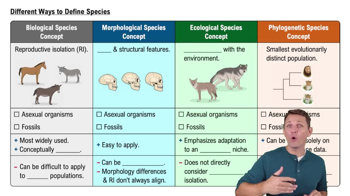
Biological Species Concept
Defines species based on reproductive isolation.
What is a major limitation of the Biological Species Concept?
It does not apply to asexual organisms or fossils.
Morphological Species Concept
Defines species based on structural features and shape.
Why is the Morphological Species Concept useful for fossils?
Because it relies on shape and structure, which are often all that is available in fossils.
Ecological Species Concept
Defines species based on their interactions with the environment.
Can the Ecological Species Concept be applied to asexual organisms?
Yes, because asexual organisms interact with their environment.
Phylogenetic Species Concept
Defines species as the smallest evolutionarily distinct populations, often using DNA data.
What is a strength of the Phylogenetic Species Concept?
It can be based solely on DNA sequence data, which is easy to obtain.
Reproductive Isolation
A key factor in the Biological Species Concept, where different species cannot interbreed.
What is a drawback of the Morphological Species Concept?
It can be subjective and may not align with reproductive isolation.
Ecological Niche
The role and position a species has in its environment, emphasized in the Ecological Species Concept.
Why might the Phylogenetic Species Concept create too many species?
It can break populations into more species than is helpful, based on minor genetic differences.
Asexual Organisms
Organisms that reproduce without mating, posing a challenge for the Biological Species Concept.
What is a limitation of the Ecological Species Concept?
It does not directly consider reproductive isolation.
Fossils
Remains of ancient organisms, often used in the Morphological Species Concept.
Why is the Biological Species Concept conceptually simple?
It defines species based on whether they are reproductively isolated.
Phylogenetic Tree
A diagram showing evolutionary relationships, used in the Phylogenetic Species Concept.
What is a challenge of applying the Biological Species Concept in natural populations?
It requires knowing all potential mating interactions of an organism.
Morphology
The study of the form and structure of organisms, central to the Morphological Species Concept.
Why might the Morphological Species Concept be easy to apply?
It only requires studying the shape and structure of organisms.
Gene Flow
The transfer of genetic material between populations, relevant in the Ecological Species Concept.
What is a benefit of the Phylogenetic Species Concept for unknown organisms?
DNA sequence data can be obtained even if little else is known about the organism.
Adaptation
A trait that helps an organism survive and reproduce, emphasized in the Ecological Species Concept.
Why might the Phylogenetic Species Concept be difficult to apply to fossils?
It can be hard to get enough resolution from fossil data to build clear phylogenetic trees.
Structural Features
Physical characteristics of an organism, used in the Morphological Species Concept.
What is a positive aspect of the Ecological Species Concept?
It emphasizes adaptation to an ecological niche.
Evolutionarily Distinct Populations
Populations that are genetically unique, central to the Phylogenetic Species Concept.
Why is the Biological Species Concept widely used?
It is conceptually simple and aligns with the idea that reproductive isolation is required for speciation.
 BackBack
 03:42
03:42