A population is defined as all individuals of the same species living in the same area at the same time, with boundaries that can be natural or arbitrarily set by ecologists.
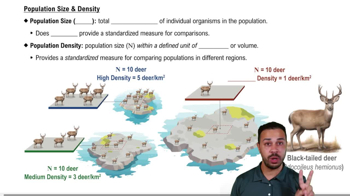
Why is population density a more useful metric than population size for comparing populations in different regions?
Population density accounts for the area occupied, allowing standardized comparisons of how crowded populations are, regardless of the size of the region.
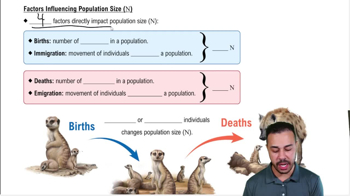
How do births and immigration affect a population?
Births and immigration add individuals to a population, increasing its size.
What is a metapopulation?
A metapopulation is a group of spatially separated local populations of the same species that are connected by migration.
Why are metapopulations generally more stable than local populations?
Metapopulations are more stable because migration between local populations can recolonize extinct patches, reducing the risk of total extinction.
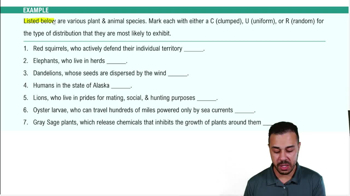
What characterizes a clumped dispersion pattern and why is it common?
Clumped dispersion occurs when individuals aggregate in groups or patches, often due to resource distribution or social behaviors, and is the most common pattern in nature.
What is random dispersion and when does it typically occur?
Random dispersion is when individuals are spaced unpredictably, often seen in plants with wind-dispersed seeds.
Can a population exhibit more than one type of dispersion pattern over time?
Yes, a population's dispersion pattern can change over time and is not limited to just one type.
What is the significance of using arbitrary versus natural boundaries in defining populations?
Arbitrary boundaries are set by researchers for convenience, while natural boundaries are defined by physical features; both help in focusing ecological studies.
What is the relationship between resource distribution and dispersion patterns in populations?
Resource distribution often influences dispersion patterns; clumped resources lead to clumped dispersion, while uniform resources and competition can lead to uniform dispersion.
What is a single population made of in population ecology?
A single population is made of all the organisms of the same species living in the same area at the same time.
What is the difference between population density and population distribution?
Population density refers to the number of individuals per unit area or volume, indicating how crowded a population is, while population distribution (dispersion) describes the spatial arrangement or pattern of individuals within the area, such as clumped, uniform, or random.
How do population density and population distribution differ?
Population density measures how many individuals occupy a given area or volume, whereas population distribution describes how those individuals are spaced within that area (clumped, uniform, or random patterns).
A population is composed of individuals of what?
A population is composed of individuals of the same species living in the same area at the same time.
What is the difference between a sample and a population in population ecology?
A population includes all individuals of a species in a defined area, while a sample is a subset of individuals from that population used to estimate characteristics of the whole population.
How do scientists calculate population density?
Scientists calculate population density by dividing the total number of individuals (population size) by the area or volume they occupy: Population Density = Number of Individuals / Area (or Volume).
How is a population defined in biology?
A population is defined as all organisms of the same species living in the same area at the same time.
Which group of organisms constitutes a population?
A group of organisms of the same species living in the same area at the same time constitutes a population.
What is physiological population density?
Physiological population density refers to the number of individuals per unit of area of land that is actually usable or habitable by the population, rather than the total area.
What are the three common patterns of population distribution?
The three common patterns of population distribution are clumped, uniform, and random.
What does population density mean in ecology?
Population density means the number of individuals of a species per unit area or volume, indicating how crowded the population is.
What is population density in population ecology?
Population density is the number of individuals of a species per unit area or volume.
How is population density defined?
Population density is defined as the number of individuals in a population divided by the area or volume they occupy.
What is a map that shows population distribution called?
A map that shows population distribution is called a population map.
How is population density calculated in ecology?
Population density is calculated by dividing the total number of individuals by the area or volume they occupy: Population Density = Number of Individuals / Area (or Volume).
What is the method to find population density?
To find population density, divide the total number of individuals by the area or volume they occupy.
How do you calculate population density?
Population density is calculated using the formula: Population Density = Number of Individuals / Area (or Volume).
What is the distinction between population density and population distribution?
Population density quantifies how many individuals are present per unit area or volume, while population distribution describes how those individuals are spaced within the area (clumped, uniform, or random).
What is the formula for population density?
The formula for population density is: Population Density = Number of Individuals / Area (or Volume).
How do you determine population density in a given area?
To determine population density, divide the total number of individuals by the area or volume they occupy.
What is a resource population in ecology?
A resource population refers to a population that serves as a source of individuals for other populations, often through migration or recolonization, as seen in metapopulations.
What is the formula for calculating population density?
Population Density = Number of Individuals / Area (or Volume).
 Back
Back
 01:48
01:48