What is found in the external covering of gram-positive cells?
The external covering of gram-positive cells contains a thick layer of peptidoglycan.
Which three structures comprise a bacterial flagellum?
A bacterial flagellum is comprised of the filament, hook, and basal body.
Can you label the structures of a prokaryotic cell?
Yes, the structures of a prokaryotic cell include the nucleoid, ribosomes, cell membrane, cell wall, and sometimes structures like pili, flagella, and a glycocalyx.
Where is lipopolysaccharide (LPS) located in bacterial cells?
Lipopolysaccharide (LPS) is located in the outer membrane of gram-negative bacterial cells.
What surrounds the cell membrane of most bacteria and provides structure and protection?
The cell wall surrounds the cell membrane of most bacteria and provides structure and protection.
What structures are present in a bacterial cell?
Structures present in a bacterial cell include the nucleoid, ribosomes, cell membrane, cell wall, and sometimes pili, flagella, and a glycocalyx.
Which structure maintains the shape of a bacterial cell?
The cell wall maintains the shape of a bacterial cell.
Which are functions of the prokaryote cell wall?
Functions of the prokaryote cell wall include providing structural support, maintaining cell shape, and protecting against osmotic pressure.
Peptidoglycan is a molecule that is found where in a bacterial cell?
Peptidoglycan is found in the cell wall of bacterial cells.
Which of these is a cell wall component that contributes to invasiveness?
Lipopolysaccharide (LPS) in gram-negative bacteria contributes to invasiveness.
What do prokaryotes have?
Prokaryotes have a nucleoid, ribosomes, a cell membrane, and a cell wall, but lack a nucleus and membrane-bound organelles.
What components make up the prokaryotic cell envelope?
C) Cell wall, cell membrane, and outer membrane
What are the characteristics of the glycocalyx found in bacteria?
D) All of the above
Why is it important to understand the structure of a bacterial cell when developing an antibiotic?
Understanding the structure of a bacterial cell is crucial for developing antibiotics that target specific components, such as the cell wall, without harming human cells.
Which structures can be found in prokaryotic cells?
B) Ribosomes
What part of a bacterial cell does gram staining allow scientists to learn about?
Gram staining allows scientists to learn about the structure of the bacterial cell wall.
Which prokaryotic feature is complex?
The cell envelope, especially in gram-negative bacteria, is complex due to the presence of an outer membrane and lipopolysaccharides.
Lipopolysaccharide is a component of the cell membrane of which cell type?
Lipopolysaccharide is a component of the outer membrane of gram-negative bacterial cells.
What is a component of the cell wall of mycobacteria?
Mycolic acid
What is the structural difference between gram-positive and gram-negative bacteria?
Gram-positive bacteria have a thick peptidoglycan layer, while gram-negative bacteria have a thin peptidoglycan layer and an outer membrane containing lipopolysaccharides.
Which shape is not one of the most common prokaryotic cell shapes?
Cuboidal
Which structures are found only in prokaryotic cells?
Structures unique to prokaryotic cells include the nucleoid and peptidoglycan cell wall.
Which bacterial structure functions in attachment to surfaces?
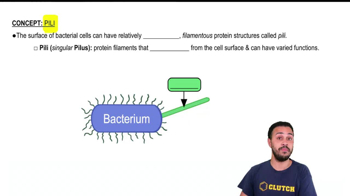
Fimbriae function in attachment to surfaces.
What structures are found within prokaryotic cells?
Structures found within prokaryotic cells include the nucleoid, ribosomes, and sometimes plasmids.
Which structure is found in prokaryotes and not in animal cells?
The nucleoid is found in prokaryotes and not in animal cells.
What organelles do prokaryotes have?
Prokaryotes do not have membrane-bound organelles but have ribosomes for protein synthesis.
What is the function of the prokaryotic cell wall?
The function of the prokaryotic cell wall is to provide structural support, maintain cell shape, and protect against osmotic pressure.
What are examples of external structures of prokaryotic cells?
 Back
Back
 01:46
01:46