 Back
BackProteins exam

 08:02
08:02
Terms in this set (28)
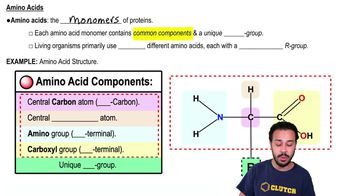
Amino Acid
The monomer unit of proteins, consisting of a central carbon atom, an amino group, a carboxyl group, a hydrogen atom, and a unique R group.
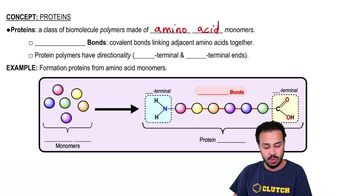
What is a peptide bond?
A covalent bond that links adjacent amino acids in a protein chain.
N-terminal end
The end of a protein or polypeptide chain that has a free amino group.
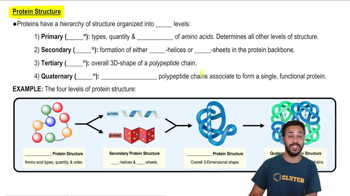
What is the primary structure of a protein?
The sequence of amino acids in a protein chain.
C-terminal end
The end of a protein or polypeptide chain that has a free carboxyl group.
What are the common components of all amino acids?
A central carbon atom, an amino group, a carboxyl group, and a hydrogen atom.
R group
The unique side chain of an amino acid that determines its properties.
What is the secondary structure of a protein?
The formation of alpha helices and beta sheets in the protein backbone.
Oligopeptide
A short chain of amino acids, typically between 2 and 20.
What is the tertiary structure of a protein?
The overall three-dimensional shape of a polypeptide chain.
Polypeptide
A long chain of amino acids, typically more than 50.
What is the quaternary structure of a protein?
The association of multiple polypeptide chains to form a single functional protein.
Denatured protein
A protein that has lost its shape and functionality due to environmental changes.
What can cause a protein to denature?
Changes in pH, temperature, or salt concentration.
Chaperone proteins
Proteins that assist other proteins in regaining their original shape.
What is the role of chaperone proteins?
To help denatured proteins reform their original shapes.
Alpha helix
A common secondary structure in proteins, resembling a coiled spring.
What is a beta sheet?
A secondary structure in proteins characterized by a zigzag folding pattern.
Protein
One or multiple polypeptide chains in their folded or functional forms.
How many common amino acids are there?
20
What determines the primary structure of a protein?
The types, quantity, and sequence of amino acids.
What is the significance of the primary structure?
It dictates all other levels of protein structure.
Functional protein
A protein that has a specific shape and can perform its biological function.
What is the difference between a peptide and a polypeptide?
A peptide has fewer than 50 amino acids, while a polypeptide has more than 50.
What is the role of hemoglobin?
To transport oxygen in red blood cells.
What happens when a protein loses its shape?
It becomes nonfunctional.
What is the backbone of an amino acid?
The central carbon atom, amino group, carboxyl group, and hydrogen atom.
What does the term 'oligo' mean in oligopeptide?
A few.