Back

Introduction to Protists quiz #4

Control buttons has been changed to "navigation" mode.
1/12
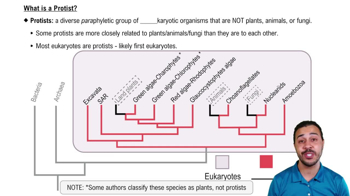
  • Why are protists considered a paraphyletic group, and what does this imply about their evolutionary relationships?

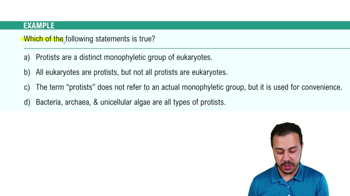
    Protists are considered a paraphyletic group because they include the most recent common ancestor of eukaryotes but not all its descendants, as plants, animals, and fungi are excluded. This implies that protists are evolutionarily diverse and do not form a single, unified lineage.
  • How do protists obtain nutrients, and what are the main nutritional strategies observed in this group?

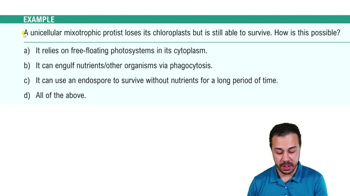
    Protists obtain nutrients through various strategies: some are heterotrophic (consuming other organisms), some are photosynthetic (producing their own food using light), and others are mixotrophic, combining both methods.
  • Why are protists considered a paraphyletic group?

    Protists are considered paraphyletic because they include the most recent common ancestor of eukaryotes but not all its descendants, as plants, animals, and fungi are excluded.
  • What does the paraphyletic nature of protists imply about their evolutionary relationships?

    It implies that protists are evolutionarily diverse and do not form a single, unified lineage, making their relationships complex and debated.
  • What are the three main nutritional strategies observed in protists?

    Protists can be heterotrophic, photosynthetic, or mixotrophic, combining both methods.
  • What is a pellicle, and what function does it serve in some protists?

    A pellicle is a strip of proteins beneath the cell membrane that provides rigidity to the cell structure in some protists.
  • How do contractile vacuoles help protists survive in hypotonic environments?

    Contractile vacuoles absorb excess water and contract to expel it from the cell, preventing the cell from lysing.
  • What is an ocelloid, and what is its function in protists?

    An ocelloid is an eye-like structure in some protists that allows them to visually detect their surroundings.
  • In what types of environments are protists most commonly found?

    Protists are most commonly found in wet, moist soils and aquatic ecosystems, where they are often the most abundant organisms.
  • Why is it difficult to define a single unique characteristic for all protists?

    Protists are so diverse that there is no single characteristic unique to all protists and not found in other eukaryotes.
  • Which disease is caused by the animal-like parasite Plasmodium?

    Plasmodium, an animal-like protist, causes the disease malaria.
  • Why are protozoans considered animal-like among protists?

    Protozoans are considered animal-like because they are heterotrophic protists that obtain nutrients by ingesting other organisms, similar to animals.