Skip to main content
General Biology
My Course
Learn
Exam Prep
AI Tutor
Study Guides
Textbook Solutions
Flashcards
Explore
Try the app
My Course
Learn
Exam Prep
AI Tutor
Study Guides
Textbook Solutions
Flashcards
Explore
Try the app
Back
Eukaryotic Supergroups: Exploring Protist Diversity quiz #2
You can tap to flip the card.
Protists that move via extension of pseudopodia are members of which eukaryotic supergroup?
You can tap to flip the card.
👆
Protists that move via extension of pseudopodia are members of which eukaryotic supergroup?
Protists that move via extension of pseudopodia are members of the SAR clade, specifically the Rhizarians.
Track progress
Control buttons has been changed to "navigation" mode.
1/10
Related flashcards
Related practice
Recommended videos
Protist Lineages definitions
Eukaryotic Supergroups: Exploring Protist Diversity
15 Terms
Protist Lineages quiz #1
Eukaryotic Supergroups: Exploring Protist Diversity
11 Terms
Protist Lineages exam
Eukaryotic Supergroups: Exploring Protist Diversity
26 Terms
Protist Lineages
27. Protists
7 problems
Topic
Jason
Protist Life Cycles
27. Protists
4 problems
Topic
KeyshawnDavis
27. Protists
4 topics
6 problems
Chapter
Nicole
03:01
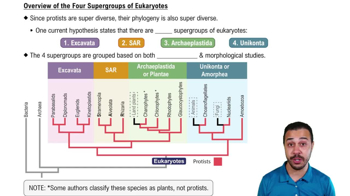
Overview of the Four Supergroups of Eukaryotes
2679
views
30
rank
Terms in this set (10)
Hide definitions
Protists that move via extension of pseudopodia are members of which eukaryotic supergroup?
Protists that move via extension of pseudopodia are members of the SAR clade, specifically the Rhizarians.
Which eukaryotic supergroup contains fungi and animals?
Unikonta is the eukaryotic supergroup that contains fungi and animals.
What are the four supergroups of eukaryotes mentioned in the video?
The four supergroups of eukaryotes are Excavata, SAR clade, Archaeplastida, and Unikonta.
Which supergroup includes organisms like diatoms and dinoflagellates?
The SAR clade includes organisms like diatoms and dinoflagellates.
What is the primary basis for grouping the four eukaryotic supergroups?
The primary basis for grouping the four eukaryotic supergroups is genetic studies.
Which supergroup is sometimes referred to as 'plantae' in some textbooks?
The supergroup Archaeplastida is sometimes referred to as 'plantae' in some textbooks.
What is the significance of the term 'Unikonta' in the context of eukaryotic supergroups?
The term 'Unikonta' refers to a supergroup that includes animals and fungi, and it is slowly being replaced by the term 'Amorphea'.
Which protist group is known for utilizing cilia for movement and feeding?
Ciliates are the protist group known for utilizing cilia for movement and feeding.
What is the evolutionary significance of protists as highlighted in the summary?
Protists highlight evolutionary significance through their diverse reproductive strategies and complex life cycles.
Which supergroup includes green algae and land plants?
The supergroup Archaeplastida includes green algae and land plants.
 BackBack

 03:01
03:01