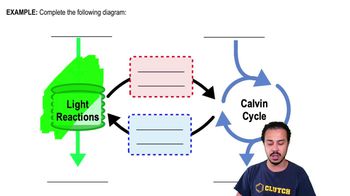
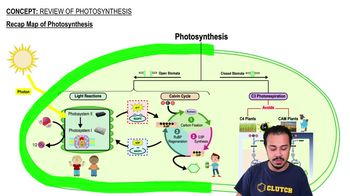
What are the two main stages of photosynthesis, and where does each occur within the chloroplast?
The two main stages of photosynthesis are the light reactions, which occur in the thylakoids, and the Calvin cycle, which takes place in the stroma of the chloroplast.
How do the light reactions of photosynthesis contribute to the Calvin cycle?
The light reactions produce ATP and NADPH, which provide the energy and reducing power needed for the Calvin cycle to convert carbon dioxide into glucose.
What is photorespiration, and how do C4 and CAM plants minimize its effects?
Photorespiration is a process that occurs when the enzyme rubisco fixes oxygen instead of carbon dioxide, wasting energy. C4 plants minimize photorespiration by separating the light reactions and Calvin cycle into different cell types, while CAM plants fix carbon dioxide at night to reduce water loss and photorespiration.
What are the three phases of the Calvin cycle, and what is the main product generated?
The three phases of the Calvin cycle are carbon fixation, reduction (G3P synthesis), and regeneration of RuBP. The main product generated is glucose.
What are the two main stages of photosynthesis and where does each occur within the chloroplast?
The two main stages are the light reactions, which occur in the thylakoids, and the Calvin cycle, which takes place in the stroma of the chloroplast.
What are the main products of the light reactions in photosynthesis?
The main products are ATP, NADPH, and oxygen gas.
How do the light reactions of photosynthesis contribute to the Calvin cycle?
The light reactions produce ATP and NADPH, which provide the energy and reducing power needed for the Calvin cycle to convert carbon dioxide into glucose.
What are the three phases of the Calvin cycle and what is the main product generated?
The three phases are carbon fixation, reduction (G3P synthesis), and regeneration of RuBP; the main product is glucose.
What is photorespiration and how do C4 and CAM plants minimize its effects?
Photorespiration occurs when rubisco fixes oxygen instead of carbon dioxide, wasting energy. C4 plants separate the light reactions and Calvin cycle into different cell types, while CAM plants fix carbon dioxide at night to reduce water loss and photorespiration.
What role do stomata play in photosynthesis and how does their position affect the process?
Stomata control gas exchange by opening to allow carbon dioxide in and oxygen out. When closed, they prevent water loss but also limit carbon dioxide entry, which can lead to photorespiration.
What four substances are recycled during photosynthesis and cellular respiration?
The four substances recycled during photosynthesis and cellular respiration are water, carbon dioxide, oxygen, and glucose.
What is the main output of photosynthesis?
The main output of photosynthesis is glucose, with oxygen also produced as a byproduct.
What is the primary product formed during photosynthesis?
The primary product formed during photosynthesis is glucose.
What is the main result of photosynthesis in plants?
The main result of photosynthesis in plants is the production of glucose.
What are the products of photosynthesis?
The products of photosynthesis are glucose and oxygen.
What are the end products of photosynthesis?
The end products of photosynthesis are glucose and oxygen.
Which four substances are recycled during photosynthesis?
The four substances recycled during photosynthesis are water, carbon dioxide, oxygen, and glucose.
Which molecule is not a product of photosynthesis but a reactant?
Carbon dioxide is not a product of photosynthesis; it is a reactant.
What are the outputs of photosynthesis?
The outputs of photosynthesis are glucose and oxygen.
What are the two main products of photosynthesis?
The two main products of photosynthesis are glucose and oxygen.
What are the products generated by photosynthesis?
Photosynthesis generates glucose and oxygen as products.
What is a product of photosynthesis?
A product of photosynthesis is glucose.
What four substances are recycled in photosynthesis and respiration?
Water, carbon dioxide, oxygen, and glucose are recycled in photosynthesis and respiration.
What is the chemical reaction for photosynthesis?
The chemical reaction for photosynthesis is: 6CO₂ + 6H₂O + light energy → C₆H₁₂O₆ + 6O₂.
What is the formula for photosynthesis?
The formula for photosynthesis is: 6CO₂ + 6H₂O + light energy → C₆H₁₂O₆ + 6O₂.
What is the word equation for photosynthesis?
The word equation for photosynthesis is: carbon dioxide + water + light energy → glucose + oxygen.
What can be used to measure the rate of photosynthesis?
The rate of photosynthesis can be measured by monitoring oxygen production, carbon dioxide uptake, or changes in glucose concentration.
What do photosynthesis and respiration have in common?
Photosynthesis and respiration both involve the cycling of water, carbon dioxide, oxygen, and glucose, and are essential for energy conversion in cells.
What is the equation for photosynthesis in words?
The equation for photosynthesis in words is: carbon dioxide plus water plus light energy yields glucose and oxygen.
Which chemical equation represents photosynthesis?
The chemical equation representing photosynthesis is: 6CO₂ + 6H₂O + light energy → C₆H₁₂O₆ + 6O₂.
Which chemical reaction shows photosynthesis?
Photosynthesis is shown by the reaction: 6CO₂ + 6H₂O + light energy → C₆H₁₂O₆ + 6O₂.
What is the correct equation for photosynthesis?
The correct equation for photosynthesis is: 6CO₂ + 6H₂O + light energy → C₆H₁₂O₆ + 6O₂.
How are photosynthesis and cellular respiration similar?
Photosynthesis and cellular respiration are similar because both involve the transformation of energy and the cycling of water, carbon dioxide, oxygen, and glucose.
How can the rate of photosynthesis be measured?
The rate of photosynthesis can be measured by tracking oxygen production, carbon dioxide consumption, or glucose formation.
How are photosynthesis and cellular respiration related?
Photosynthesis and cellular respiration are related because the products of one process serve as the reactants for the other, forming a cycle of energy and matter in living organisms.
How can you measure the rate of photosynthesis in a plant?
You can measure the rate of photosynthesis in a plant by observing oxygen output, carbon dioxide uptake, or changes in glucose levels.
How are photosynthesis and cellular respiration connected to each other?
Photosynthesis and cellular respiration are connected because photosynthesis produces glucose and oxygen, which are used in cellular respiration to generate energy, water, and carbon dioxide.
How is the rate of photosynthesis measured?
The rate of photosynthesis is measured by monitoring the amount of oxygen produced, carbon dioxide consumed, or glucose synthesized over time.
 Back
Back

 08:50
08:50