Signal Amplification quiz #1 Flashcards

Signal Amplification quiz #1
Control buttons has been changed to "navigation" mode.
1/10
  • What is signal amplification in cellular communication, and how do protein kinases and protein phosphatases contribute to this process?
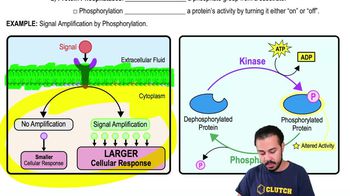
    Signal amplification is the process by which a single signaling molecule binding to its receptor leads to the activation of many intracellular molecules, resulting in a larger cellular response. Protein kinases contribute by adding phosphate groups to proteins (phosphorylation), often activating them and amplifying the signal through phosphorylation cascades. Protein phosphatases remove phosphate groups, deactivating proteins and helping to turn off or dampen the response.
  • What is a phosphorylation cascade, and why is it important for signal amplification in cells?
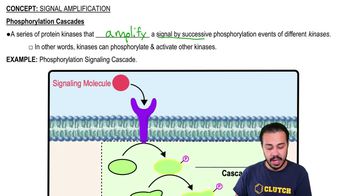
    A phosphorylation cascade is a series of events where one protein kinase activates another by phosphorylation, which then activates another kinase, and so on. This chain reaction amplifies the original signal, allowing a small number of signaling molecules to produce a large cellular response. Phosphorylation cascades are crucial for efficient and regulated signal amplification in many biosignaling pathways.
  • What is signal amplification in cellular communication?
    Signal amplification is when a single signaling molecule binding to its receptor leads to the activation of many intracellular molecules, resulting in a larger cellular response.
  • How do protein kinases contribute to signal amplification?
    Protein kinases add phosphate groups to proteins (phosphorylation), often activating them and amplifying the signal through phosphorylation cascades.
  • What is the role of protein phosphatases in cellular signaling?
    Protein phosphatases remove phosphate groups from proteins, deactivating them and helping to turn off or dampen the cellular response.
  • What is a phosphorylation cascade?
    A phosphorylation cascade is a series of events where one protein kinase activates another by phosphorylation, which then activates another kinase, and so on.
  • Why are phosphorylation cascades important for signal amplification?
    Phosphorylation cascades amplify the original signal, allowing a small number of signaling molecules to produce a large cellular response.
  • What happens to a protein when it is phosphorylated by a kinase?
    Phosphorylation typically alters a protein's activity, either activating or deactivating it depending on the specific protein and scenario.
  • How does the removal of a phosphate group by a phosphatase affect a protein?
    The removal of a phosphate group by a phosphatase usually returns the protein to its original, often inactive, state.
  • What is the source of the phosphate group that kinases add to proteins during phosphorylation?
    The phosphate group added by kinases typically originates from ATP, which is hydrolyzed to ADP during the process.