How does facilitated diffusion differ from simple diffusion?
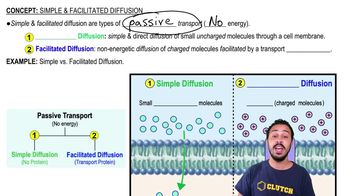
Facilitated diffusion involves transport proteins to assist charged molecules across the membrane, while simple diffusion allows small uncharged molecules to pass directly through the membrane without any assistance.
By which mechanism would a steroid molecule diffuse into the cell?
A steroid molecule would diffuse into the cell through simple diffusion, as it is typically small and uncharged.
What is simple diffusion?
Simple diffusion is the passive transport of small uncharged molecules directly through the cell membrane from an area of high concentration to an area of low concentration without the need for transport proteins.
What is the difference between simple diffusion and facilitated diffusion?
The difference is that simple diffusion does not require transport proteins, while facilitated diffusion uses transport proteins to help move charged molecules across the membrane.
What is facilitated diffusion?
Facilitated diffusion is a type of passive transport that uses transport proteins to move charged molecules across the cell membrane from high to low concentration without energy input.
What is a similarity between simple diffusion and facilitated diffusion?
Both simple diffusion and facilitated diffusion are passive transport processes that move molecules from areas of high concentration to areas of low concentration without requiring energy.
What is false about facilitated diffusion?
It requires energy input.
How does simple diffusion differ from facilitated diffusion?
Simple diffusion does not involve transport proteins and is limited to small uncharged molecules, whereas facilitated diffusion uses transport proteins to move charged molecules.
What is the similarity between simple diffusion and facilitated diffusion?
Both processes move molecules from high to low concentration and do not require energy input.
What best describes the process of facilitated diffusion?
Passive transport using transport proteins.
How is facilitated diffusion different from simple diffusion?
Facilitated diffusion uses transport proteins to assist charged molecules, while simple diffusion allows uncharged molecules to pass directly through the membrane.
Which process is an example of facilitated transport? A) Osmosis. B) Diffusion of oxygen. C) Ion transport through channels. D) Active transport of glucose.
C) Ion transport through channels.
In facilitated diffusion, what role do transport proteins play?
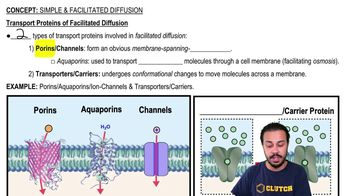
Transport proteins assist in moving charged molecules across the cell membrane by providing a pathway or undergoing conformational changes.
What describes simple diffusion?
Simple diffusion is the passive movement of small uncharged molecules directly through the cell membrane from high to low concentration.
What characteristic do simple diffusion and facilitated diffusion share?
Both are passive transport processes that move molecules from high to low concentration without energy input.
What are the similarities and differences between diffusion and facilitated diffusion?
Both are passive transport processes moving molecules from high to low concentration. Simple diffusion does not require transport proteins, while facilitated diffusion does.
How does facilitated diffusion occur across a cell membrane?
It uses transport proteins.
What role do carrier proteins play in facilitated diffusion?
Carrier proteins undergo conformational changes to transport molecules across the cell membrane.
What is an example of facilitated diffusion?
Transport of glucose via carrier proteins.
What is the difference between facilitated diffusion and simple diffusion?
Facilitated diffusion uses transport proteins for charged molecules, while simple diffusion allows uncharged molecules to pass directly through the membrane.
Facilitated diffusion?
Facilitated diffusion is passive transport using transport proteins to move charged molecules across the membrane from high to low concentration.
How is simple diffusion different from other types of passive transport?
Simple diffusion does not require transport proteins and is limited to small uncharged molecules, unlike facilitated diffusion which uses transport proteins.
What characteristic is not true of facilitated diffusion?
Requires energy input.
How is simple diffusion different from facilitated diffusion?
Simple diffusion does not involve transport proteins and is limited to small uncharged molecules, whereas facilitated diffusion uses transport proteins to move charged molecules.
What factor increases the rate of facilitated diffusion?
Increase in transport protein availability.
What is the difference between facilitated diffusion and diffusion?
Facilitated diffusion uses transport proteins for charged molecules, while simple diffusion allows uncharged molecules to pass directly through the membrane.
During facilitated diffusion, what is the role of transport proteins?
Transport proteins assist in moving charged molecules across the cell membrane by providing a pathway or undergoing conformational changes.
What is the main difference between simple diffusion and facilitated diffusion across a cell membrane?
Simple diffusion allows small uncharged molecules to pass directly through the membrane without the help of proteins, while facilitated diffusion requires transport proteins to help charged or larger molecules cross the membrane.
What types of molecules typically use facilitated diffusion instead of simple diffusion?
Charged molecules, such as ions, and larger polar molecules typically use facilitated diffusion because they cannot easily cross the hydrophobic core of the membrane without assistance from transport proteins.
What role do aquaporins play in facilitated diffusion?
Aquaporins are a type of channel protein that specifically facilitate the rapid movement of water molecules across the cell membrane, enhancing the process of osmosis.
 Back
Back
 05:10
05:10