During translation, the ribosome reads mRNA codons and pairs them with tRNA anticodons to add amino acids to a growing polypeptide chain.
What is the end product of translation?
The end product of translation is a polypeptide chain, which will fold into a functional protein.
What occurs when a ribosome reaches a stop codon?
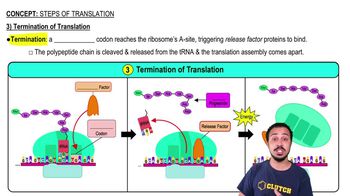
When a ribosome reaches a stop codon, a release factor binds, triggering the release of the polypeptide chain and disassembly of the translation complex.
How is translation terminated?
Translation is terminated when a stop codon is reached, leading to the binding of a release factor that cleaves the polypeptide chain and disassembles the ribosome.
What is the last step in the initiation phase of translation?
Binding of the large ribosomal subunit
How does the tRNA-mRNA interaction ensure that the amino acids are added in the correct order?
The tRNA-mRNA interaction ensures correct amino acid order by matching tRNA anticodons with complementary mRNA codons.
When does translation termination occur in relation to ribosome interaction?
When a ribosome interacts with a stop codon
What facilitates the binding of tRNA anticodons to mRNA codons?
Ribosome
What causes translation to stop?
Translation stops when a stop codon is reached, triggering the binding of a release factor.
Which occurs during translation elongation?
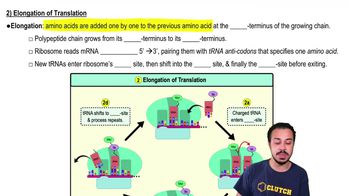
During translation elongation, amino acids are added to the growing polypeptide chain through peptide bonds.
What would you expect to find bound to the stop codon at the A site?
A release factor would be bound to the stop codon at the A site.
What is the first event to take place in translation in eukaryotes?
Binding of the small ribosomal subunit to mRNA
What occurs during translation?
During translation, mRNA is decoded by the ribosome to produce a polypeptide chain.
What occurs when a ribosome reaches a stop codon?
A release factor binds, leading to the release of the polypeptide chain and disassembly of the ribosome.
Which step occurs in the P site of the ribosome during translation?
In the P site, peptide bonds are formed between amino acids.
What occurs when a ribosome encounters a stop codon?
A release factor binds, causing the polypeptide chain to be released and the ribosome to disassemble.
What happens during translation elongation regarding peptide bonds?
Peptide bonds form between amino acids
During the elongation stage of translation, what happens?
During elongation, tRNAs bring amino acids to the ribosome, where they are added to the growing polypeptide chain.
What would terminate translation?
Translation is terminated by the binding of a release factor to a stop codon.
What signifies translation termination?
Stop codon
What are the three phases of translation?
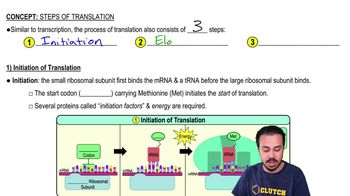
The three phases of translation are initiation, elongation, and termination.
What process occurs when termination of translation takes place?
Binding of release factor
Which description matches each stage of translation?
Initiation: Ribosome assembly and start codon recognition; Elongation: Addition of amino acids; Termination: Stop codon recognition and polypeptide release.
What is the correct order of steps for protein synthesis?
The correct order is initiation, elongation, and termination.
What happens during translation elongation?
During elongation, tRNAs bring amino acids to the ribosome, where peptide bonds are formed.
Which is not a step of translation? A) Initiation B) Elongation C) Replication
C) Replication
What is the final product of the process of translation?
The final product of translation is a polypeptide chain.
What molecule plays a part in translational elongation?
tRNA
What are the three main steps of translation, and what occurs during each step?
The three main steps of translation are initiation, elongation, and termination. During initiation, the small ribosomal subunit binds to mRNA and the first tRNA (carrying methionine) at the start codon (AUG), followed by the large ribosomal subunit joining. In elongation, amino acids are sequentially added to the growing polypeptide chain as tRNAs bring them to the ribosome's A site, peptide bonds form, and the ribosome moves along the mRNA. Termination occurs when a stop codon is reached, triggering a release factor to bind, which releases the completed polypeptide and disassembles the translation complex.
 Back
Back

 04:59
04:59