What are the repetitive DNA sequences present at the ends of eukaryotic chromosomes called?
The repetitive DNA sequences present at the ends of eukaryotic chromosomes are called telomeres.
What is the name of the regions at the ends of eukaryotic chromosomes?
The regions at the ends of eukaryotic chromosomes are called telomeres.
What are the short repeats of DNA found on the ends of eukaryotic chromosomes called?
Telomeres
What type of molecule does telomerase use as a template?
RNA
How does telomerase prevent linear chromosomes from shortening during replication?
Telomerase prevents linear chromosomes from shortening by adding repetitive nucleotide sequences to the ends of telomeres, thus maintaining their length.
What is the name of the region at the ends of eukaryotic chromosomes?
Telomeres
Why do bacteria not need telomerase?
Bacteria do not need telomerase because they have circular chromosomes, which do not have ends that require protection from shortening.
Why are telomeres a necessary component of linear chromosomes?
Telomeres are necessary because they protect the ends of linear chromosomes from degradation and prevent the loss of genetic information during DNA replication.
What happens to telomeres with each cell division?
They shorten with each cell division
Telomere shortening is a problem in which types of cells?
Telomere shortening is a problem in somatic cells, as it can lead to aging and cessation of cell division.
How does the enzyme telomerase meet the challenge of replicating the ends of linear chromosomes?
Telomerase extends the telomeres by adding repetitive nucleotide sequences, thus preventing the loss of important DNA during replication.
What is the function of telomeres in chromosomes?
They protect chromosomes from degradation
Where would you expect to find telomerase activity?
Telomerase activity is typically found in germ cells and cancer cells, where it helps maintain telomere length for continuous cell division.
Which biological process is not related to telomeres?
Protein synthesis
What are telomeres and where are they located in eukaryotic chromosomes?
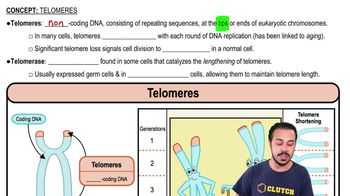
Telomeres are non-coding, repetitive DNA sequences found at the ends of eukaryotic chromosomes, where they protect genetic information during cell division.
What is the role of the enzyme telomerase in certain cells?
Telomerase is an enzyme that maintains or lengthens telomeres, allowing cells such as germ cells and cancer cells to continue dividing without telomere shortening.
 Back
Back

 04:25
04:25