Back

The Human Population definitions

Control buttons has been changed to "navigation" mode.
1/15
  • Exponential Growth

    A population increase pattern where numbers double at a constant rate, often surpassed by recent human trends.
  • Density-Dependent Factor

    A limiting influence, such as disease, whose effects intensify as population size increases.
  • Contraception

    A voluntary method or device used to prevent pregnancy, contributing to lower birth rates.
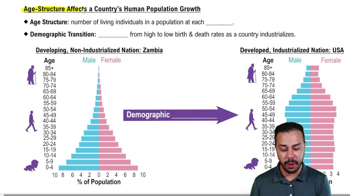
  • Age Structure

    The distribution of individuals among different age groups within a population, often visualized as a pyramid.
  • Developed Nation

    A country with industrialization, low birth and death rates, and a balanced age structure.
  • Developing Nation

    A country with high birth and death rates, low life expectancy, and a bottom-heavy age structure.
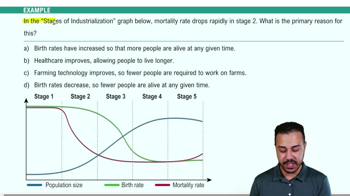
  • Demographic Transition

    The shift from high to low birth and death rates as a country industrializes.
  • Carrying Capacity

    The maximum population size that the environment can sustainably support given available resources.
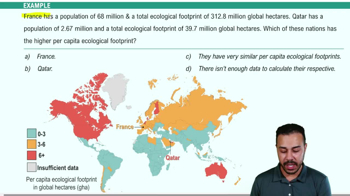
  • Ecological Footprint

    A measure of the land and water area required to support a person's or group's resource use and waste.
  • Global Hectare

    A standardized unit representing a hectare with world-average biological productivity, used for footprint comparisons.
  • Mortality Rate

    The frequency of deaths within a population, often higher in developing regions.
  • Survivorship

    The proportion of individuals surviving from one age group to the next within a population.
  • Life Expectancy

    The average number of years an individual is expected to live, influenced by birth and death rates.
  • Industrialization

    The process of economic and social transformation marked by increased manufacturing and technological advancement.
  • Resource Use

    The consumption of natural materials and energy by humans, impacting sustainability and ecological balance.