How does age structure differ between developing and developed nations, and what is the demographic transition?
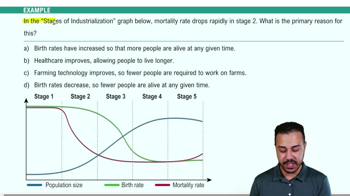
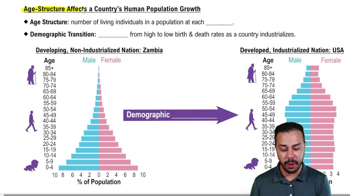
Developing nations have bottom-heavy age structures with many young individuals, high birth and death rates, and low life expectancy. Developed nations have more balanced age structures, low birth and death rates, and high life expectancy. The demographic transition is the shift from high to low birth and death rates as a country industrializes.
What factors have contributed to the rapid increase in human population growth over the last four centuries?
Advances in agriculture, medicine, health care, living conditions, and technology have contributed to rapid human population growth.
Since the 1960s, what trend has been observed in the human population growth rate?
The human population growth rate has been decreasing since the 1960s and is projected to continue decreasing.
What are two main reasons for the recent decline in human population growth rate?
Density-dependent factors like disease and voluntary population control methods such as contraception have contributed to the decline.
How is age structure typically represented, and what information does it provide?
Age structure is often shown as a pyramid, displaying the number of individuals in each age group, which reveals information about a country's development and population dynamics.
Describe the typical age structure and life expectancy of developing nations.
Developing nations have bottom-heavy age structures with many young individuals, high birth and death rates, and low life expectancy.
How do developed nations differ in age structure and life expectancy compared to developing nations?
Developed nations have more balanced age structures, low birth and death rates, and higher life expectancy.
What is the demographic transition?
The demographic transition is the shift from high birth and death rates to low birth and death rates as a country industrializes.
What is an ecological footprint, and how is it measured?
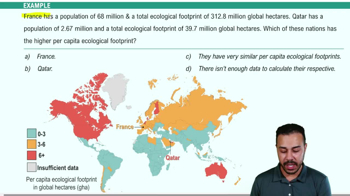
An ecological footprint is the amount of land and water needed to support human activities, measured in global hectares (GHA).
Why is the current average human ecological footprint considered unsustainable?
The average ecological footprint per person (2.7 GHA) exceeds the maximum sustainable footprint (1.5 GHA), meaning humans are using resources faster than nature can regenerate them.
Describe three ways to slow human population growth.
Three ways to slow human population growth are: (1) increasing access to and use of contraception, (2) implementing policies that encourage smaller family sizes, and (3) improving education and healthcare, which can reduce birth rates.
Which fertility rate keeps the population size stable?
A fertility rate at replacement level, where each couple has just enough children to replace themselves (typically about 2.1 children per woman in developed countries), keeps the population size stable.
What is the approximate current population of the United States?
The approximate current population of the United States is over 300 million people.
What happened to the world's population between 1950 and 2000?
Between 1950 and 2000, the world's population increased dramatically, growing faster than exponential models predicted, largely due to advances in agriculture, medicine, and technology.
What is population momentum?
Population momentum is the continued population growth that occurs even after birth rates decline, due to a relatively high proportion of individuals in the childbearing age group.
Approximately how much of the world's population lives in cities?
Approximately half of the world's population lives in cities.
What is the formula for human population change?
The formula for human population change is: Population Change = (Births + Immigration) - (Deaths + Emigration).
What was the population of the United States in 1945?
The population of the United States in 1945 was approximately 140 million people.
When did the world's population reach 1 billion?
The world's population reached 1 billion around the early 1800s.
How does age structure affect population growth in developing versus developed nations?
Developing nations have a bottom-heavy age structure with many young individuals, leading to high birth and death rates, while developed nations have a more balanced age structure with lower birth and death rates, resulting in slower population growth.