Skip to main content
General Biology
My Course
Learn
Exam Prep
AI Tutor
Study Guides
Textbook Solutions
Flashcards
Explore
Try the app
My Course
Learn
Exam Prep
AI Tutor
Study Guides
Textbook Solutions
Flashcards
Explore
Try the app
Back
Tropisms and Hormones quiz #2
You can tap to flip the card.
Which response occurs because of the hormone auxin?
You can tap to flip the card.
👆
Which response occurs because of the hormone auxin?
Auxin causes roots to bend toward higher concentrations of the hormone, influencing growth direction.
Track progress
Control buttons has been changed to "navigation" mode.
1/10
Related flashcards
Related practice
Recommended videos
Tropisms and Hormones quiz #1
Tropisms and Hormones
30 Terms
Tropisms and Hormones definitions
Tropisms and Hormones
12 Terms
Tropisms and Hormones exam
Tropisms and Hormones
29 Terms
Tropisms and Hormones
37. Plant Sensation and Response
7 problems
Topic
Jason
Plant Defenses
37. Plant Sensation and Response
3 problems
Topic
Jason
37. Plant Sensation and Response
3 topics
7 problems
Chapter
Jason
05:19
Thigmotropism and Cytokinins
3396
views
13
rank
08:18
Plant Hormones and Senescence
2412
views
10
rank
1
comments
05:39
Gravitropism
1960
views
7
rank
Terms in this set (10)
Hide definitions
Which response occurs because of the hormone auxin?
Auxin causes roots to bend toward higher concentrations of the hormone, influencing growth direction.
What is the external stimulus in thigmotropism?
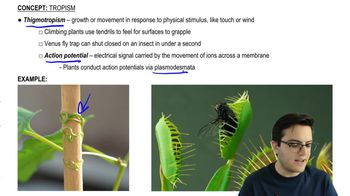
The external stimulus in thigmotropism is touch, which causes plants to respond by growing and wrapping around objects.
Which situation most likely involves the hormone gibberellin?
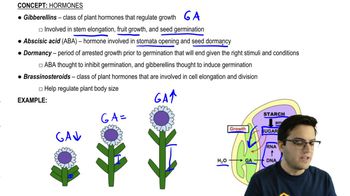
Gibberellin is involved in stem elongation, fruit growth, and seed germination.
How do statoliths help plants sense gravity?
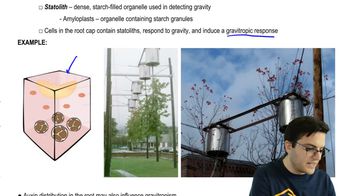
Statoliths are dense amyloplasts that sink to the bottom of cells, activating sensory signals to help plants sense gravity.
What role does ethylene play in plant senescence?
Ethylene triggers enzymes that degrade cell walls, leading to leaf abscission and fruit ripening.
How do plants use action potentials in thigmotropism?
Plants use action potentials to rapidly respond to touch, allowing movements like the closing of a Venus flytrap.
What is the function of cytokinins in plant growth?
Cytokinins regulate growth by influencing the cell cycle and promoting cell division.
How does abscisic acid affect seed dormancy?
Abscisic acid inhibits germination, maintaining seed dormancy until favorable conditions arise.
What is the effect of gibberellins on internode length?
Gibberellins increase internode length, leading to longer stems in plants.
How do plants respond to wind as a physical stimulus?
Plants restrict vertical growth in response to wind to prevent damage and maintain stability.
 BackBack
 05:19
05:19