Which is not a virulence factor of Bordetella pertussis?
Ribosomes are not a virulence factor of Bordetella pertussis.
What bacterial defenses against viral infection include restriction enzymes and CRISPR?
Both restriction enzymes and CRISPR serve as bacterial defenses against infection by viruses.
What enzymes are contained within the HIV virion particle?
All of the above: reverse transcriptase, integrase, and protease are enzymes contained within the HIV virion particle.
Which viral lineages tend to predominate?
RNA viruses tend to predominate due to their high mutation rates and adaptability.
What is the advantage of the lytic life cycle?
The advantage of the lytic life cycle is the rapid production and release of new viral particles, allowing for quick spread to new host cells.
What components are brought into a cell by HIV?
All of the above: reverse transcriptase, integrase, and protease are brought into a cell by HIV.
What portion of an enveloped animal virus binds to the host cell plasma membrane?
The glycoproteins on the viral envelope bind to the host cell plasma membrane.
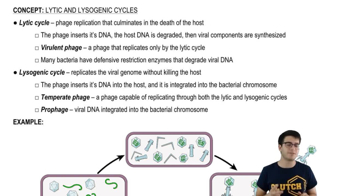
How are the lysogenic and lytic cycles different?
The lysogenic cycle involves integration of the viral genome into the host's DNA without immediate destruction, while the lytic cycle results in host cell destruction.
Which organism requires a vector for transmission?
Malaria requires a vector, specifically the Anopheles mosquito.
How does the nucleic acid of T-even bacteriophages enter the host cell?
The nucleic acid of T-even bacteriophages is injected into the host cell through the tail structure.
Which STD is caused by a virus?
Herpes is caused by a virus.
What event occurs during the lytic life cycle of phages?
During the lytic life cycle, the phage replicates its genome and produces new viral particles, leading to host cell lysis.
How do enveloped animal viruses exit their host?
Enveloped animal viruses exit their host through a process called budding, where they acquire their envelope from the host cell membrane.
What part of the bacteriophage gets injected into a bacterial cell?
The genetic material of the bacteriophage, either DNA or RNA, gets injected into the bacterial cell.
Which is not a category of virulence factors: toxins, enzymes, ribosomes, or adhesion factors?
Ribosomes are not a category of virulence factors.
What happens during the lytic cycle?
During the lytic cycle, the virus replicates its genome and produces new viral particles, leading to the destruction of the host cell.
What happens in the lytic cycle?
In the lytic cycle, the virus replicates its genome and produces new viral particles, leading to the destruction of the host cell.
Which viral life cycle would result in a quicker death for an infected cell?
The lytic cycle would result in a quicker death for an infected cell.
What part of the phage entered the bacterial cell following infection?
The genetic material of the phage, either DNA or RNA, entered the bacterial cell following infection.
Which virus may cause a persistent viral infection?
HIV may cause a persistent viral infection.
What is a true statement about lysogeny regarding the destruction of the host cell?
Lysogeny does not result in immediate destruction of the host cell.
What do viruses do once they invade a living cell of a host?
Once inside a host cell, viruses hijack the host's cellular machinery to replicate their genetic material and produce new viral particles.
What is required to maintain a lysogenic state?
The presence of a repressor protein is required to maintain a lysogenic state.
What is not an example of a protein that some viruses carry inside their capsid?
Ribosomes are not an example of a protein that viruses carry inside their capsid.
From where are the lipids that make up the HIV envelope derived?
The lipids that make up the HIV envelope are derived from the host cell membrane.
What are the advantages to a virus of the lysogenic cycle?
The lysogenic cycle allows the virus to persist in the host without killing it, potentially spreading to new cells during host cell division.
What are the advantages of entering a lysogenic cycle?
Entering a lysogenic cycle allows the virus to integrate into the host genome and remain dormant, avoiding detection by the host's immune system.
Which structure allows a virus to recognize and attach to receptors on the host cell?
The glycoproteins on the viral envelope allow a virus to recognize and attach to receptors on the host cell.
What distinguishes a lysogenic infection from a lytic infection?
A lysogenic infection involves integration of the viral genome into the host's DNA without immediate destruction, while a lytic infection results in host cell destruction.
What structure do many animal viruses acquire when exiting a host cell?
Many animal viruses acquire a viral envelope when exiting a host cell.
Which viral process involves integration into the host genome?
The lysogenic cycle describes a process that involves viral integration into the host genome.
Viruses are not made up of cells. According to cell theory, what does this imply about viruses?
According to cell theory, viruses are not considered living organisms because they are not made up of cells.
Which protein is essential for the maintenance of the lysogenic state?
A repressor protein is essential for the maintenance of the lysogenic state.
How is latency of animal viruses different from lysogeny of phages?
Latency in animal viruses involves dormancy without integration into the host genome, while lysogeny involves integration of the viral genome into the host DNA.
Which stage is not part of the lytic cycle: attachment, penetration, integration, or lysis?
Integration is not a stage in the lytic cycle.
Which of these diseases does not have a human reservoir: HIV, influenza, rabies, or smallpox?
Rabies does not have a human reservoir; it primarily affects animals.
What are viable methods of release of newly assembled viral particles?
Lysis and budding are viable methods of release of newly assembled viral particles.
 Back
Back
 05:
05: