Pearson+ LogoPearson+ Logo
Ch. 35 Behavioral Adaptations to the Environment
Taylor - Campbell Biology: Concepts & Connections 10th Edition
Taylor, Simon, Dickey, Hogan10th EditionCampbell Biology: Concepts & ConnectionsISBN: 9780136538783Not the one you use?Change textbook
Chapter 35, Problem 2

Although many chimpanzee populations live in environments containing oil palm nuts, members of only a few populations use stones to crack open the nuts. The most likely explanation for this behavioral difference between populations is that
a. Members of different populations differ in manual dexterity.
b. Members of different populations have different nutritional requirements.
c. Members of different populations differ in learning ability.
d. The use of stones to crack nuts has arisen and spread through social learning in only some populations.

Verified step by step guidance
1
Understand the context of the problem: The question is about behavioral differences in chimpanzee populations and why only some populations use stones to crack open oil palm nuts, despite living in similar environments.
Eliminate options that are less likely based on biological reasoning: For example, consider whether manual dexterity (option a) is likely to vary significantly between populations of the same species. Chimpanzees generally have similar physical capabilities, so this is unlikely to be the main reason.
Evaluate the role of nutritional requirements (option b): All chimpanzees have similar dietary needs, so differences in nutritional requirements are unlikely to explain why only some populations use stones to crack nuts.
Consider learning ability (option c): While learning ability can vary among individuals, it is unlikely to differ significantly between entire populations of the same species. This makes this option less plausible.
Focus on social learning (option d): Behavioral traits like tool use often spread through social learning, where individuals observe and imitate others. If only some populations exhibit this behavior, it is likely because the behavior originated in those populations and spread through social learning, rather than being an innate or physical difference.

Verified video answer for a similar problem:

This video solution was recommended by our tutors as helpful for the problem above.
Video duration:
2m
Was this helpful?

Key Concepts

Here are the essential concepts you must grasp in order to answer the question correctly.

Social Learning

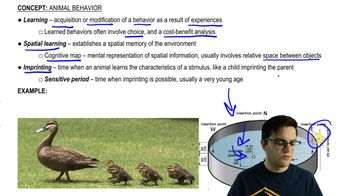
Social learning refers to the process by which individuals acquire new behaviors or knowledge by observing and imitating others. In the context of chimpanzees, this concept suggests that the use of tools, such as stones for cracking nuts, may be passed down through generations within certain populations, leading to variations in behavior based on cultural transmission.
Recommended video:
Guided course
05:37
Learning and Communication

Cultural Variation

Cultural variation in animal behavior highlights how different populations of the same species can develop distinct practices based on their social structures and environments. This concept is crucial for understanding why some chimpanzee groups utilize tools while others do not, as these behaviors can be influenced by the unique experiences and interactions within each group.
Recommended video:
02:16
Sources of Genetic Variation

Manual Dexterity

Manual dexterity refers to the skillful use of the hands to manipulate objects. While it may play a role in the ability to use tools, the question suggests that differences in manual dexterity alone are unlikely to explain the observed behavioral differences among chimpanzee populations, as the presence of social learning and cultural factors are more significant in shaping these behaviors.
Recommended video:
Guided course
06:28
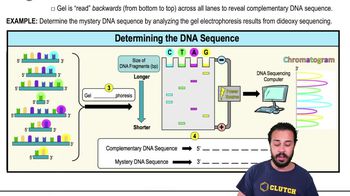
Determining the DNA Sequence from a Gel
Related Practice
Textbook Question

Complete this map, which reviews the genetic and environmental components of animal behavior and their relationship to learning.

<IMAGE>

688
views
Textbook Question

Pheasants do not feed their chicks. Immediately after hatching, a pheasant chick starts pecking at seeds and insects on the ground. How might a behavioral ecologist explain the ultimate cause of this behavior?

a. Pecking is an innate behavior

b. Pheasants learned to peck, and their offspring inherited this behavior

c. Pecking by newly hatched chicks is the result of trial-and-error learning

d. Pecking is a result of imprinting during a sensitive period.

751
views
Textbook Question

A male redwing blackbird will chase predatory birds away from his breeding territory during nesting season. Which hypothesis best explains his behavior?

a. He is acting for the good of the species. He may die, but other birds of his species will be saved.

b. He knows this will increase his fitness, so he chases away the predator.

c. He carries a gene that causes fathers to protect their offspring, which increases inclusive fitness.

d. He has imprinted on the offspring in his nest, so he knows that they are his.

738
views
Textbook Question

Some airports have attempted to scare geese off by playing goose alarm calls over loudspeakers. This tactic kept the geese away initially, but soon the geese ignored the alarm calls. How would you explain this outcome?

a. The alarm calls are a social signal that geese ignore unless they can see the other geese.

b. The geese became imprinted on the alarm calls.

c. The geese used spatial learning to navigate the environment of the airport.

d. The geese became habituated to the alarm calls when no danger was present.

813
views