Pearson+ LogoPearson+ Logo
Ch. 20 Unifying Concepts of Animal Structure and Function
Taylor - Campbell Biology: Concepts & Connections 10th Edition
Taylor, Simon, Dickey, Hogan10th EditionCampbell Biology: Concepts & ConnectionsISBN: 9780136538783Not the one you use?Change textbook
Chapter 20, Problem 7

Which of the following best illustrates homeostasis? (Explain your answer.)
a. Most adult humans are between 5 and 6 feet tall.
b. All the cells of the body are about the same size.
c. When the salt concentration of the blood goes up, the kidneys expel more salt.
d. When oxygen in the blood decreases, you feel dizzy.

Verified step by step guidance
1
Step 1: Begin by understanding the concept of maintaining a stable internal environment despite changes in the external environment. This is a fundamental biological process known as homeostasis.
Step 2: Evaluate the options provided in the question. Thermoregulation refers specifically to the regulation of body temperature, which is a subset of homeostasis. Homeostasis, on the other hand, encompasses a broader range of processes, including temperature regulation, pH balance, and more.
Step 3: Consider the other options: Defecation is the process of eliminating waste from the digestive system, and Evaporation is a physical process where liquid turns into vapor. Neither of these directly relates to maintaining internal stability.
Step 4: Recognize that the term describing the protection of the internal environment against external changes is 'Homeostasis,' as it is the overarching concept that includes various regulatory mechanisms.
Step 5: Conclude that the correct answer is 'Homeostasis,' as it best fits the description provided in the question.

Key Concepts

Here are the essential concepts you must grasp in order to answer the question correctly.

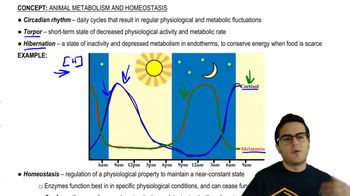
Homeostasis

Homeostasis is the biological process through which living organisms maintain a stable internal environment despite external changes. This involves regulating factors such as temperature, pH, and ion concentrations to ensure optimal functioning of cells and systems. For example, humans maintain a body temperature around 37°C, adjusting through mechanisms like sweating or shivering.
Recommended video:

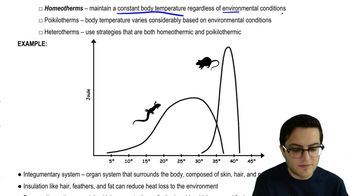
Thermoregulation

Thermoregulation is a specific aspect of homeostasis that focuses on maintaining an organism's body temperature within a certain range. This process can involve physiological responses such as altering blood flow, sweating, or shivering to either dissipate or conserve heat. It is crucial for the survival of endothermic (warm-blooded) animals, which rely on internal mechanisms to regulate their temperature.
Recommended video:
Guided course
09:51
Thermoregulation

External Environment

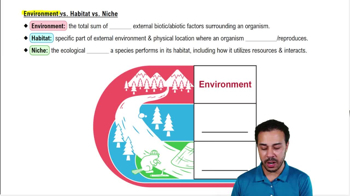
The external environment refers to all the external factors that can influence an organism's internal conditions, including temperature, humidity, and availability of resources. Changes in the external environment can pose challenges to homeostasis, prompting organisms to adapt through behavioral or physiological changes. Understanding these interactions is essential for studying how organisms survive and thrive in varying conditions.
Recommended video:
Guided course
01:57
Environment vs. Habitat vs. Niche
Related Practice
Textbook Question

Negative-feedback mechanisms are

a. Most often involved in maintaining homeostasis.

b. Analogous to a furnace that produces heat.

c. Found only in birds and mammals.

d. All of the above.

1147
views
Textbook Question
Briefly explain how the structure of each of these tissues is well suited to its function: stratified squamous epithelium in the skin, neurons in the brain, simple squamous epithelium lining the lung, bone in the skull.
1648
views
Textbook Question
Describe ways in which the bodies of complex animals are structured for exchanging materials with the environment. Do all animals share such features?
799
views
Textbook Question

The diaphragm is a large sheet of muscle that helps move air in and out of your lungs. Breathing is automatically controlled by the brain, but you can choose to hold your breath or breathe deeper. What kind of muscle do you suppose makes up the diaphragm? (Explain your answer.)

2401
views
Textbook Question

You read a blog that states, 'A squid's eye has been perfectly designed to see in the dark depths of the ocean.' Draft a paragraph that responds to the blog's use of the phrase 'perfect design' by citing an example discussed in this chapter.

735
views
Textbook Question

In a study to examine the effectiveness of a new acne cream, participants were assigned to one of two groups: those who would be asked to use the cream for three months and those who would not use any treatment. Participants would be asked to keep a journal rating how bad they think their acne is on a scale of 1–10 each week. What are the well-designed aspects of this study? What are the limitations? How would you improve the design of this study to address these limitations?

757
views