Pearson+ LogoPearson+ Logo
Ch. 20 Unifying Concepts of Animal Structure and Function
Taylor - Campbell Biology: Concepts & Connections 10th Edition
Taylor, Simon, Dickey, Hogan10th EditionCampbell Biology: Concepts & ConnectionsISBN: 9780136538783Not the one you use?Change textbook
Chapter 20, Problem 6

Describe ways in which the bodies of complex animals are structured for exchanging materials with the environment. Do all animals share such features?

Verified step by step guidance
1
Identify the various systems in complex animals that are involved in material exchange. These include the respiratory system for gas exchange, the digestive system for nutrient absorption, and the circulatory system for distributing substances throughout the body.
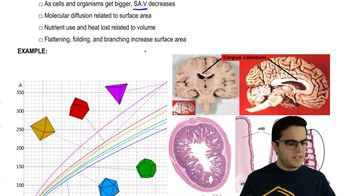
Examine the structural adaptations that enhance material exchange in these systems. For example, the alveoli in lungs provide a large surface area for gas exchange, while villi and microvilli in the intestines increase the surface area for nutrient absorption.
Discuss the role of the circulatory system in transporting materials. The heart pumps blood through vessels, reaching various tissues and facilitating the exchange of nutrients, gases, and wastes at the cellular level.
Explore the concept of homeostasis and how it relates to material exchange. Homeostasis involves maintaining a stable internal environment, which is crucial for efficient material exchange and overall functioning of the body.
Consider variations among different animal groups. While all complex animals have systems for material exchange, the specific structures and mechanisms can vary. For example, aquatic animals may use gills for gas exchange, while terrestrial animals typically use lungs.

Verified video answer for a similar problem:

This video solution was recommended by our tutors as helpful for the problem above.
Video duration:
2m
Was this helpful?

Key Concepts

Here are the essential concepts you must grasp in order to answer the question correctly.

Surface Area to Volume Ratio

The surface area to volume ratio is a critical concept in biology that describes how the size of an organism affects its ability to exchange materials with its environment. As organisms increase in size, their volume grows faster than their surface area, making it more challenging to efficiently exchange gases, nutrients, and waste. Complex animals have evolved specialized structures, such as lungs and gills, to maximize surface area and facilitate these exchanges.
Recommended video:
Guided course
07:47
Surface Area to Volume Ratio

Circulatory Systems

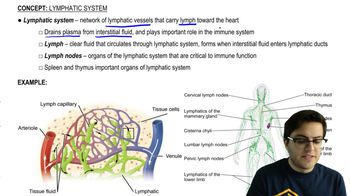
Circulatory systems are essential for transporting materials throughout complex animals. These systems can be open or closed, allowing for the efficient distribution of oxygen, nutrients, and hormones to cells while removing waste products. In larger animals, a closed circulatory system, like that found in mammals, ensures that blood circulates quickly and can reach all tissues, enhancing the exchange of materials with the environment.
Recommended video:
Guided course
02:15
Lymphatic System

Respiratory Structures

Respiratory structures, such as lungs in mammals and gills in fish, are specialized adaptations that facilitate gas exchange between the organism and its environment. These structures increase the surface area available for oxygen uptake and carbon dioxide release, allowing for efficient respiration. While all animals require some form of gas exchange, the specific structures and mechanisms can vary widely, reflecting the diversity of adaptations to different environments.
Recommended video:
Guided course
04:25
Community Structure
Related Practice
Textbook Question

Which of the following body systems facilitates (but doesn't regulate) the functions of the other systems? respiratory system endocrine system digestive system circulatory system

1467
views
Textbook Question

Negative-feedback mechanisms are

a. Most often involved in maintaining homeostasis.

b. Analogous to a furnace that produces heat.

c. Found only in birds and mammals.

d. All of the above.

1147
views
Textbook Question
Briefly explain how the structure of each of these tissues is well suited to its function: stratified squamous epithelium in the skin, neurons in the brain, simple squamous epithelium lining the lung, bone in the skull.
1648
views
Textbook Question

Which of the following best illustrates homeostasis? (Explain your answer.)

a. Most adult humans are between 5 and 6 feet tall.

b. All the cells of the body are about the same size.

c. When the salt concentration of the blood goes up, the kidneys expel more salt.

d. When oxygen in the blood decreases, you feel dizzy.

1095
views
Textbook Question

The diaphragm is a large sheet of muscle that helps move air in and out of your lungs. Breathing is automatically controlled by the brain, but you can choose to hold your breath or breathe deeper. What kind of muscle do you suppose makes up the diaphragm? (Explain your answer.)

2401
views
Textbook Question

You read a blog that states, 'A squid's eye has been perfectly designed to see in the dark depths of the ocean.' Draft a paragraph that responds to the blog's use of the phrase 'perfect design' by citing an example discussed in this chapter.

735
views