Pearson+ LogoPearson+ Logo
Ch. 30 How Animals Move
Taylor - Campbell Biology: Concepts & Connections 10th Edition
Taylor, Simon, Dickey, Hogan10th EditionCampbell Biology: Concepts & ConnectionsISBN: 9780136538783Not the one you use?Change textbook
Chapter 30, Problem 3

Arm muscles and leg muscles are arranged in antagonistic pairs. How does this affect their functioning?
a. It provides a backup if one of the muscles is injured.
b. One muscle of the pair pushes while the other pulls.
c. A single motor neuron can control both of them.
d. It allows the muscles to produce opposing movements.

Verified step by step guidance
1
Understand the concept of antagonistic muscle pairs: These are pairs of muscles that work in opposition to each other to produce movement. When one muscle contracts, the other relaxes, allowing for controlled and opposing movements.
Analyze the options provided in the question: Each option describes a potential function of antagonistic muscle pairs. Evaluate each option based on biological principles.
Option a: 'It provides a backup if one of the muscles is injured.' This is incorrect because antagonistic pairs are not designed as backups; they are meant to work together for movement.
Option b: 'One muscle of the pair pushes while the other pulls.' This is incorrect because muscles can only contract (pull); they cannot push. Movement is achieved by one muscle contracting while the other relaxes.
Option d: 'It allows the muscles to produce opposing movements.' This is correct because antagonistic pairs enable movements in opposite directions, such as bending and straightening a joint.

Verified video answer for a similar problem:

This video solution was recommended by our tutors as helpful for the problem above.
Video duration:
2m
Was this helpful?

Key Concepts

Here are the essential concepts you must grasp in order to answer the question correctly.

Antagonistic Muscle Pairs

Antagonistic muscle pairs consist of two muscles that work against each other to facilitate movement. When one muscle contracts, the other relaxes, allowing for controlled and coordinated movements. This arrangement is crucial for activities such as bending and straightening limbs, as it enables smooth transitions between opposing actions.
Recommended video:
Guided course
02:08
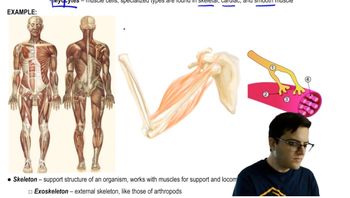
Muscle System and Skeleton

Muscle Contraction Mechanism

Muscle contraction occurs through the sliding filament theory, where actin and myosin filaments within muscle fibers slide past each other to shorten the muscle. This process is initiated by signals from motor neurons, which stimulate the muscle fibers to contract. Understanding this mechanism is essential for grasping how antagonistic pairs function during movement.
Recommended video:
Guided course
02:40
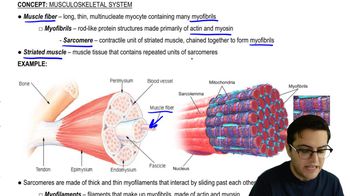
Muscle Fibers and Sarcomeres

Coordination of Movement

Coordination of movement involves the precise timing and control of muscle contractions to achieve desired actions. Antagonistic pairs play a vital role in this coordination, as they allow for opposing movements that stabilize joints and maintain balance. This interplay is fundamental for activities ranging from walking to complex athletic maneuvers.
Recommended video:
Guided course
08:52
Air Movement and Partial Pressure