Pearson+ LogoPearson+ Logo
Ch. 30 How Animals Move
Taylor - Campbell Biology: Concepts & Connections 10th Edition
Taylor, Simon, Dickey, Hogan10th EditionCampbell Biology: Concepts & ConnectionsISBN: 9780136538783Not the one you use?Change textbook
Chapter 30, Problem 4

Gravity would have the least effect on the movement of which of the following? (Explain your answer.)
a. A salmon
b. A snake
c. A sparrow
d. A grasshopper

Verified step by step guidance
1
Step 1: Understand the concept of gravity and its effect on organisms. Gravity is the force that pulls objects toward the center of the Earth. The impact of gravity on movement depends on the organism's mode of locomotion and its interaction with the environment.
Step 2: Analyze the movement of a salmon. Salmon primarily move through water, where buoyancy counteracts gravity. This reduces the direct effect of gravity on their movement compared to terrestrial organisms.
Step 3: Analyze the movement of a snake. Snakes move on land using muscular contractions and friction with the ground. Gravity plays a significant role in their movement as they must overcome it to maintain contact with the surface.
Step 4: Analyze the movement of a sparrow. Sparrows are birds that fly, and while gravity affects their flight, they counteract it using lift generated by their wings. Gravity is a factor, but their ability to fly reduces its impact compared to terrestrial organisms.
Step 5: Analyze the movement of a grasshopper. Grasshoppers move by jumping, which requires them to overcome gravity during the upward motion. Gravity significantly affects their movement as they must exert force to propel themselves upward and then fall back down due to gravity.

Verified video answer for a similar problem:

This video solution was recommended by our tutors as helpful for the problem above.
Video duration:
3m
Was this helpful?

Key Concepts

Here are the essential concepts you must grasp in order to answer the question correctly.

Gravity

Gravity is a fundamental force that attracts objects with mass towards one another. On Earth, it affects all objects, but its impact varies based on the object's mass and the medium through which it moves. Understanding how gravity influences movement is crucial for analyzing the locomotion of different animals.
Recommended video:

Body Mass and Size

The body mass and size of an organism play significant roles in how gravity affects its movement. Larger and heavier animals experience greater gravitational force, which can hinder their ability to move quickly or efficiently. In contrast, smaller animals may be less affected by gravity, allowing for more agile movement.
Recommended video:
Guided course
03:33
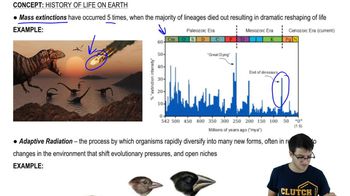
Mass Extinctions and Adaptive Radiation

Locomotion Mechanisms

Different animals have evolved various locomotion mechanisms that can mitigate the effects of gravity. For instance, flying animals like sparrows utilize wings to counteract gravitational pull, while terrestrial animals like snakes and grasshoppers rely on their body structure and movement patterns. Understanding these mechanisms helps in assessing how gravity influences their movement.
Recommended video:
Guided course
03:04
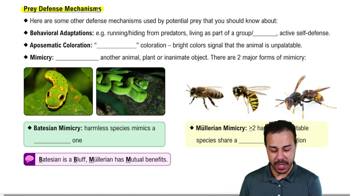
Prey Defense Mechanisms