
Pearson+ LogoPearson+ Logo
Ch. 25 Control of Body Temperature and Water Balance
Taylor - Campbell Biology: Concepts & Connections 10th Edition
Taylor, Simon, Dickey, Hogan10th EditionCampbell Biology: Concepts & ConnectionsISBN: 9780136538783Not the one you use?Change textbook
Chapter 25, Problem 25

Scientists have found that the quantity of aquaporin molecules inserted in the membranes of collecting duct cells changes in response to ADH levels. Draw a line graph proposing a relationship between ADH levels and its effect on the quantity of aquaporins. Additionally, explain how the relationship between ADH and aquaporins corresponds to situations of dehydration and hydration.

Verified step by step guidance
1
Identify the variables for the graph: The x-axis will represent the levels of ADH (Antidiuretic Hormone), and the y-axis will represent the quantity of aquaporin molecules in the membranes of collecting duct cells.
Propose a relationship: As ADH levels increase, the quantity of aquaporin molecules in the collecting duct cells is likely to increase. This is because ADH plays a role in regulating water reabsorption in the kidneys by increasing the permeability of the cell membranes to water.
Draw the line graph: Plot the data points based on the proposed relationship and draw a line that best fits these points. The line is expected to show a positive correlation between ADH levels and the quantity of aquaporins.
Explain the relationship in terms of dehydration: During dehydration, the body's ADH levels increase to promote water reabsorption in the kidneys. This is achieved by inserting more aquaporin molecules into the membranes of collecting duct cells, thus increasing water permeability and reducing water loss in urine.
Discuss the relationship in terms of hydration: Conversely, during hydration, the body's ADH levels decrease, leading to a reduction in the number of aquaporin molecules in the collecting duct cells. This decreases water reabsorption, allowing more water to be excreted in the urine, thus maintaining fluid balance.

Verified video answer for a similar problem:

This video solution was recommended by our tutors as helpful for the problem above.
Video duration:
3m
Was this helpful?

Key Concepts

Here are the essential concepts you must grasp in order to answer the question correctly.

Aquaporins

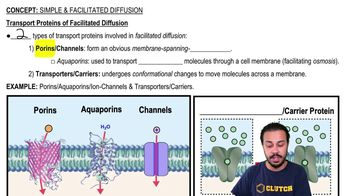
Aquaporins are specialized channel proteins embedded in cell membranes that facilitate the transport of water molecules. They play a crucial role in regulating water balance in the body, particularly in the kidneys, where they are essential for reabsorbing water from urine. The presence and quantity of aquaporins in cell membranes can be influenced by various hormones, including antidiuretic hormone (ADH).
Recommended video:
Guided course
04:49
Transport Proteins of Facilitated Diffusion

Antidiuretic Hormone (ADH)

Antidiuretic hormone (ADH), also known as vasopressin, is a hormone produced by the hypothalamus and released by the posterior pituitary gland. It regulates water retention in the body by promoting the insertion of aquaporins into the membranes of kidney collecting duct cells. Higher levels of ADH lead to increased water reabsorption, which is critical during dehydration, while lower levels result in less water being reabsorbed.
Recommended video:
Guided course
08:18
Plant Hormones and Senescence

Dehydration and Hydration

Dehydration occurs when the body loses more water than it takes in, leading to a higher concentration of solutes in the blood. In response, ADH levels increase, prompting the kidneys to insert more aquaporins into collecting duct cells, enhancing water reabsorption and concentrating urine. Conversely, during hydration, lower ADH levels result in fewer aquaporins, allowing more water to be excreted, thus diluting the urine and maintaining fluid balance.
Recommended video:
Guided course
04:53
Carbohydrates