
Pearson+ LogoPearson+ Logo
Ch. 25 Control of Body Temperature and Water Balance
Taylor - Campbell Biology: Concepts & Connections 10th Edition
Taylor, Simon, Dickey, Hogan10th EditionCampbell Biology: Concepts & ConnectionsISBN: 9780136538783Not the one you use?Change textbook
Chapter 25, Problem 22

Dolphins have an insulating layer of blubber that protects them from cold water, but their flippers are not insulated. Propose a hypothesis to explain why dolphin flippers do not freeze. Describe an experiment you could do to test your hypothesis. (You may assume you have equipment for measuring temperatures in dolphin flippers.) What results would you expect if your hypothesis is correct?

Verified step by step guidance
1
Step 1: Formulate a hypothesis. A possible hypothesis could be that the blood flow in dolphin flippers is adapted to prevent freezing by maintaining a higher temperature in the flippers compared to the surrounding water.
Step 2: Design an experiment. Use temperature sensors to measure the temperature of the water around the dolphin and the temperature inside the flippers of several dolphins swimming in cold water. Ensure to monitor and record the temperatures over a period of time to account for any changes.
Step 3: Conduct the experiment. Attach the temperature sensors to the dolphins' flippers and place additional sensors in the water. Release the dolphins into a controlled cold water environment and continuously record the temperature data.
Step 4: Analyze the data. Compare the temperature inside the flippers with the temperature of the surrounding water. Look for patterns or significant differences that support the hypothesis that dolphin flippers maintain a higher temperature.
Step 5: Draw conclusions. If the data shows that the temperature inside the flippers remains consistently higher than the surrounding water, it would support the hypothesis that the blood flow in the flippers helps prevent freezing. If the temperatures are similar, alternative hypotheses may need to be considered.

Verified video answer for a similar problem:

This video solution was recommended by our tutors as helpful for the problem above.
Video duration:
2m
Was this helpful?

Key Concepts

Here are the essential concepts you must grasp in order to answer the question correctly.

Thermoregulation

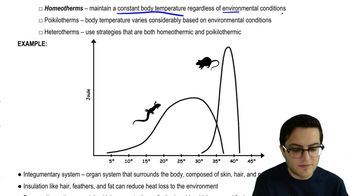
Thermoregulation is the process by which animals maintain their body temperature within certain boundaries, even when the surrounding temperature is different. In marine mammals like dolphins, this involves adaptations such as blubber, which insulates the body and reduces heat loss in cold water. Understanding thermoregulation is crucial for hypothesizing why dolphin flippers, which lack insulation, do not freeze.
Recommended video:
Guided course
09:51
Thermoregulation

Heat Exchange Mechanisms

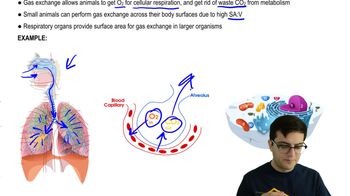
Heat exchange mechanisms refer to the ways in which organisms lose or gain heat from their environment. In dolphins, the flippers may utilize countercurrent heat exchange, where warm blood flowing from the body warms the cooler blood returning from the flippers, minimizing heat loss. This concept is essential for formulating a hypothesis about the temperature regulation in dolphin flippers.
Recommended video:
Guided course
05:55
Gas Exchange and Breathing

Experimental Design

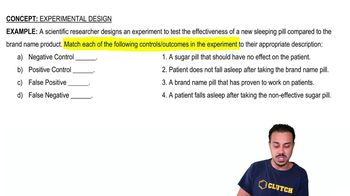
Experimental design is the process of planning an experiment to test a hypothesis effectively. It involves defining variables, selecting appropriate controls, and determining methods for data collection. In this context, designing an experiment to measure the temperature of dolphin flippers under various conditions will help validate or refute the proposed hypothesis regarding their ability to avoid freezing.
Recommended video:
Guided course
02:50
Experimental Design Example 1
Related Practice
Textbook Question
Some diuretics are on a list of substances that the International Olympic Committee has banned for use by athletes. What do diuretics do? Propose an explanation for how diuretic use could be an unfair advantage for a competitor in a sport like wrestling, in which weight classes are part of the competition.
813
views
Textbook Question
You are studying a large tropical reptile that has a high and relatively stable body temperature. How would you determine whether this animal is an endotherm or an ectotherm?
950
views
Textbook Question

For the experiment detailed in Module 25.3, describe the control and experimental groups, state the dependent variable being measured, and summarize the result.

939
views
Textbook Question
In 1847, the German biologist Christian Bergmann noted that mammals and birds living at higher latitudes (farther from the equator) are on average larger and bulkier than related species living at lower latitudes. Suggest an evolutionary hypothesis to explain this observation.
859
views
Textbook Question
Kidneys were the first organs to be transplanted successfully. A donor can live a normal life with a single kidney, making it possible for individuals to donate a kidney to an ailing relative or even an unrelated individual. In some countries, poor people sell kidneys to transplant recipients through organ brokers. What are the pros and cons associated with organ commerce?
809
views
Textbook Question
Scientists have found that the quantity of aquaporin molecules inserted in the membranes of collecting duct cells changes in response to ADH levels. Draw a line graph proposing a relationship between ADH levels and its effect on the quantity of aquaporins. Additionally, explain how the relationship between ADH and aquaporins corresponds to situations of dehydration and hydration.
982
views