
Pearson+ LogoPearson+ Logo
Ch. 6 How Cells Harvest Chemical Energy
Taylor - Campbell Biology: Concepts & Connections 10th Edition
Taylor, Simon, Dickey, Hogan10th EditionCampbell Biology: Concepts & ConnectionsISBN: 9780136538783Not the one you use?Change textbook
Chapter 6, Problem 18

For a short time in the 1930s, some physicians prescribed low doses of a compound called dinitrophenol (DNP) to help patients lose weight. This unsafe method was abandoned after some patients died. DNP uncouples the chemiosmotic machinery by making the inner mitochondrial membrane leaky to H+.
Explain how this drug could cause profuse sweating, weight loss, and possibly death.

Verified step by step guidance
1
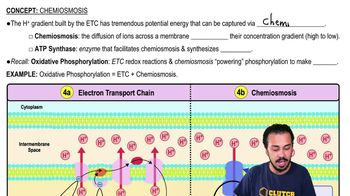
Understand the role of the inner mitochondrial membrane in cellular respiration: The inner mitochondrial membrane is crucial for the process of oxidative phosphorylation, where a proton gradient (H+ gradient) is established across the membrane. This gradient drives ATP synthesis via ATP synthase.
Recognize the effect of DNP on the proton gradient: DNP disrupts the proton gradient by making the inner mitochondrial membrane permeable to H+. This uncouples the electron transport chain from ATP synthesis, as protons can freely diffuse across the membrane without passing through ATP synthase.
Explain the consequences of uncoupling: Without the proton gradient, ATP production is severely reduced. To compensate, cells increase metabolic activity, breaking down more glucose and fat to generate energy. This leads to weight loss as stored energy reserves are depleted.
Describe the link to profuse sweating: The uncoupling of oxidative phosphorylation causes energy that would normally be used for ATP production to be released as heat. This excess heat leads to an increase in body temperature, causing profuse sweating as the body attempts to cool itself.
Discuss the potential for death: The excessive heat production can lead to hyperthermia, a dangerous condition where the body overheats. Additionally, the lack of sufficient ATP can impair critical cellular functions, potentially leading to organ failure and death.

Verified video answer for a similar problem:

This video solution was recommended by our tutors as helpful for the problem above.
Video duration:
1m
Was this helpful?

Key Concepts

Here are the essential concepts you must grasp in order to answer the question correctly.

Chemiosmosis

Chemiosmosis is the process by which ATP (adenosine triphosphate) is produced in cells through the movement of protons (H+) across a membrane. In mitochondria, this occurs when protons are pumped into the intermembrane space, creating a gradient that drives ATP synthesis as protons flow back into the mitochondrial matrix through ATP synthase. DNP disrupts this process by making the inner mitochondrial membrane permeable to protons, preventing efficient ATP production.
Recommended video:

Thermogenesis

Thermogenesis refers to the process of heat production in organisms, particularly in response to energy expenditure. When DNP uncouples oxidative phosphorylation, the energy from the electron transport chain is released as heat instead of being used to produce ATP. This results in increased body temperature and profuse sweating as the body attempts to dissipate the excess heat, contributing to weight loss through elevated metabolic rates.

Toxicity and Metabolic Imbalance

The use of DNP can lead to severe toxicity due to its ability to disrupt normal metabolic processes. By uncoupling oxidative phosphorylation, DNP causes a significant increase in metabolic rate, which can overwhelm the body's ability to regulate temperature and maintain homeostasis. This can result in hyperthermia, organ failure, and ultimately death, especially if the body cannot cope with the excessive heat and energy demands.
Recommended video:
Guided course
10:11
Prokaryote Metabolism