
Pearson+ LogoPearson+ Logo
Ch. 22 Gas Exchange
Taylor - Campbell Biology: Concepts & Connections 10th Edition
Taylor, Simon, Dickey, Hogan10th EditionCampbell Biology: Concepts & ConnectionsISBN: 9780136538783Not the one you use?Change textbook
Chapter 22, Problem 15

One of the many mutant opponents that the movie monster Godzilla contends with is Mothra, a giant mothlike creature with a wingspan of 7–8 m. Science fiction creatures like these can be critiqued on the grounds of biomechanical and physiological principles. Focusing on the principles of gas exchange that you learned about in this chapter, what problems would Mothra face? Why do you think truly giant insects are improbable?

Verified step by step guidance
1
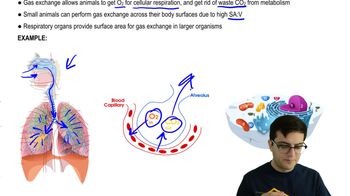
Understand the principles of gas exchange in insects: Insects breathe through a system of tubes called tracheae, which directly deliver oxygen to tissues and remove carbon dioxide. This system works well for small organisms but becomes inefficient as body size increases.
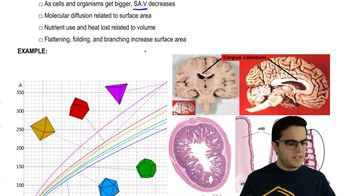
Consider the scaling of the tracheal system: As the size of an insect increases, the volume of its body grows faster than the surface area of the tracheae. This means that larger insects would need disproportionately larger tracheae to supply enough oxygen to their tissues, which could be structurally impractical.
Analyze the impact of increased body size on oxygen diffusion: The diffusion of gases through the tracheal system is effective over small distances but becomes less efficient over longer distances. In a giant insect like Mothra, the distance for oxygen to diffuse would be much greater, potentially leading to inadequate oxygen supply to cells far from the tracheal openings.
Evaluate the mechanical limitations: The exoskeleton of insects must be shed and regrown through a process called molting. Supporting a massive exoskeleton and the physical process of molting would be challenging for a giant insect due to the increased weight and the strength of materials required.
Reflect on evolutionary feasibility: From an evolutionary perspective, the constraints on respiratory efficiency, structural support, and other physiological factors make it improbable for insects to evolve into very large sizes under current Earth-like conditions.

Verified video answer for a similar problem:

This video solution was recommended by our tutors as helpful for the problem above.
Video duration:
1m
Was this helpful?

Key Concepts

Here are the essential concepts you must grasp in order to answer the question correctly.

Gas Exchange in Insects

Insects primarily rely on a tracheal system for gas exchange, where air enters through spiracles and travels through a network of tubes directly to tissues. This system is efficient for small body sizes but becomes less effective as size increases, limiting oxygen delivery and carbon dioxide removal. For a giant insect like Mothra, the increased distance for diffusion would pose significant challenges in meeting metabolic demands.
Recommended video:
Guided course
05:55
Gas Exchange and Breathing

Surface Area to Volume Ratio

The surface area to volume ratio is a critical factor in biological systems, influencing how organisms exchange materials with their environment. As an organism grows larger, its volume increases faster than its surface area, leading to decreased efficiency in processes like gas exchange. For Mothra, this means that the larger body would struggle to obtain sufficient oxygen relative to its size, making survival as a giant insect improbable.
Recommended video:
Guided course
07:47
Surface Area to Volume Ratio

Metabolic Rate and Size

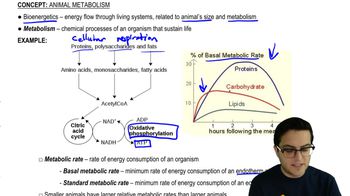
Metabolic rate refers to the rate at which an organism converts food into energy, which is influenced by its size. Larger animals generally have lower metabolic rates per unit mass compared to smaller ones, but they require more energy overall. Mothra's massive size would necessitate an extraordinarily high metabolic rate to sustain its activities, which is not feasible given the limitations of its gas exchange system and the physical constraints of being a giant insect.
Recommended video:
Guided course
07:08
Metabolic Rate
Related Practice
Textbook Question

Carbon monoxide (CO) is a colorless, odorless gas found in furnace and automobile engine exhaust and cigarette smoke. CO binds to hemoglobin 210 times more tightly than does O2. CO also binds with an electron transport protein and disrupts cellular respiration. Explain why CO is such a deadly gas.

1338
views
Textbook Question

Partial pressure reflects the relative amount of gas in a mixture and is measured in millimeters of mercury (mm Hg). Llamas are native to the Andes Mountains in South America. The partial pressure of O2 (abbreviated PO₂) in the atmosphere where llamas live is about half of the PO₂ at sea level. As a result, the PO₂ in the lungs of llamas is about 50 mm Hg, whereas that in human lungs at sea level is about 100 mm Hg. A dissociation curve for hemoglobin shows the percentage of saturation (the amount of O2 bound to hemoglobin) at increasing values of PO₂ As you see in the graph below, the dissociation curves for llama and human hemoglobin differ. Compare these two curves and explain how the hemoglobin of llamas is an adaptation to living where the air is 'thin.'

1767
views
Textbook Question

Mountain climbers often spend weeks adjusting to the lower partial pressure of oxygen at high altitudes before and during their ascent of high peaks. During that time, their bodies begin to produce more red blood cells. Some runners and cyclists prepare for competition by training at high altitudes or by sleeping in a tent in which PO₂ is kept artificially low. Explain why this training strategy may improve an athlete's performance.

781
views
Textbook Question

E-cigarettes pose a dilemma for public health officials. Because e-cigarettes produce fewer toxic chemicals than regular cigarettes, they may be a safer alternative for people who want to quit smoking but still crave nicotine. On the other hand, e-cigarettes may encourage nicotine addiction among teenagers. Evaluate the scientific evidence. Are e-cigarettes an effective aid for quitting cigarettes? What evidence supports the assertion that e-cigarettes are especially harmful to adolescents? The Centers for Disease Control website is a good place to start. cdc.gov/tobacco/basic_information/e-cigarettes/

790
views