
Pearson+ LogoPearson+ Logo
Ch. 26 Hormones and the Endocrine System
Taylor - Campbell Biology: Concepts & Connections 10th Edition
Taylor, Simon, Dickey, Hogan10th EditionCampbell Biology: Concepts & ConnectionsISBN: 9780136538783Not the one you use?Change textbook
Chapter 26, Problem 1

Complete this map, which presents some major concepts from this chapter. Flowchart illustrating the endocrine system's role in internal communication and regulation.

Verified step by step guidance
1
Identify the two main vertebrate systems responsible for internal communication and regulation: the endocrine system and the nervous system.
Determine the type of signals used by each system: the endocrine system uses chemical signals (hormones), while the nervous system uses electrical signals.
Understand that hormones are secreted into the bloodstream and bind with specific receptors on target cell surfaces or within the cells.
Recognize that hormones are produced by various glands, such as the adrenal glands, which are under the control of the hypothalamus.
Note that the adrenal glands produce hormones involved in the 'fight-or-flight' response, such as adrenaline.

Verified video answer for a similar problem:

This video solution was recommended by our tutors as helpful for the problem above.
Video duration:
1m
Was this helpful?

Key Concepts

Here are the essential concepts you must grasp in order to answer the question correctly.

Endocrine System

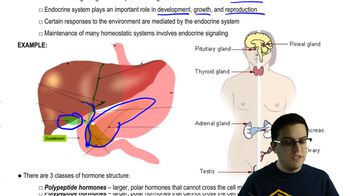
The endocrine system is a network of glands that produce and secrete hormones directly into the bloodstream. These hormones act as chemical messengers, regulating various bodily functions such as metabolism, growth, and mood. Unlike the nervous system, which uses electrical signals for rapid communication, the endocrine system operates more slowly but has lasting effects on the body.
Recommended video:
Guided course
05:55
Endocrine System

Hormones and Target Cells

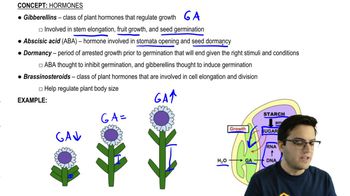
Hormones are specific signaling molecules that travel through the bloodstream to target cells, where they bind to receptors located on the cell surfaces. This binding initiates a response in the target cell, influencing its activity and function. The specificity of hormone action is determined by the presence of appropriate receptors on target cells, allowing for precise regulation of physiological processes.
Recommended video:
Guided course
08:18
Plant Hormones and Senescence

Hypothalamus and Regulation

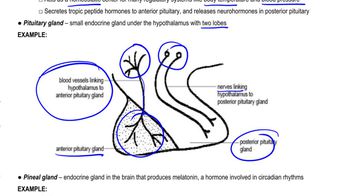
The hypothalamus is a crucial brain region that links the nervous system to the endocrine system. It regulates the release of hormones from the pituitary gland and controls various autonomic functions, including the 'fight-or-flight' response. By responding to internal and external stimuli, the hypothalamus plays a vital role in maintaining homeostasis and coordinating the body's response to stress.
Recommended video:
Guided course
03:34
Hypothalamus and Pituitary