Pearson+ LogoPearson+ Logo
Ch. 26 Hormones and the Endocrine System
Taylor - Campbell Biology: Concepts & Connections 10th Edition
Taylor, Simon, Dickey, Hogan10th EditionCampbell Biology: Concepts & ConnectionsISBN: 9780136538783Not the one you use?Change textbook
Chapter 26, Problem 2

Which correctly matches a hormone to the gland from which it is produced and to its effect on target cells?
a. Thyroid hormone: Anterior pituitary, regulates metabolism
b. Prolactin: Anterior pituitary, raises blood calcium levels
c. Androgens: Thyroid, promotes male characteristics
d. None of the choices are correct.

Verified step by step guidance
1
Step 1: Understand the question. The problem asks us to match a hormone to the gland that produces it and its effect on target cells. We need to evaluate each option to determine if the hormone, gland, and effect are correctly paired.
Step 2: Analyze option a. Thyroid hormone is indeed involved in regulating metabolism, but it is produced by the thyroid gland, not the anterior pituitary. Therefore, this option is incorrect.
Step 3: Analyze option b. Prolactin is produced by the anterior pituitary, but its primary function is to stimulate milk production in mammals, not to raise blood calcium levels. Thus, this option is also incorrect.
Step 4: Analyze option c. Androgens are hormones that promote male characteristics, but they are primarily produced by the testes (in males) and adrenal glands, not the thyroid. This makes this option incorrect as well.
Step 5: Conclude that none of the provided options correctly match a hormone to its gland and effect. Therefore, the correct answer is 'd. None of the choices are correct.'

Verified video answer for a similar problem:

This video solution was recommended by our tutors as helpful for the problem above.
Video duration:
2m
Was this helpful?

Key Concepts

Here are the essential concepts you must grasp in order to answer the question correctly.

Hormones and Glands

Hormones are chemical messengers produced by glands in the endocrine system. Each hormone is secreted by a specific gland and has distinct effects on target cells throughout the body. Understanding the relationship between hormones and their respective glands is crucial for identifying their functions and impacts on physiological processes.
Recommended video:
Guided course
08:18
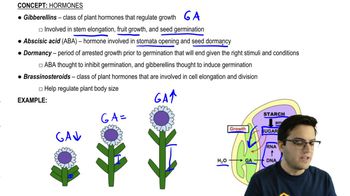
Plant Hormones and Senescence

Anterior Pituitary Functions

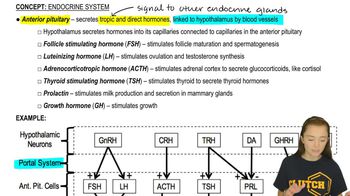
The anterior pituitary gland produces several key hormones, including prolactin and growth hormone, which regulate various bodily functions. Prolactin, for instance, is primarily involved in lactation and does not raise blood calcium levels, which is a function of parathyroid hormone. Recognizing the specific roles of anterior pituitary hormones is essential for correctly matching them to their effects.
Recommended video:
Guided course
13:19
Anterior and Posterior Pituitary

Thyroid Hormones

Thyroid hormones, primarily thyroxine (T4) and triiodothyronine (T3), are produced by the thyroid gland and play a vital role in regulating metabolism, growth, and development. They influence how the body uses energy and can affect various systems, including cardiovascular and nervous systems. Understanding the correct source and function of thyroid hormones is key to answering questions about hormonal effects.
Recommended video:
Guided course
08:18
Plant Hormones and Senescence