Pearson+ LogoPearson+ Logo
Ch. 24 The Immune System
Taylor - Campbell Biology: Concepts & Connections 10th Edition
Taylor, Simon, Dickey, Hogan10th EditionCampbell Biology: Concepts & ConnectionsISBN: 9780136538783Not the one you use?Change textbook
Chapter 24, Problem 1

Complete this concept map to summarize the key concepts concerning the body's defenses. Concept map summarizing the body's immune defenses and lymphocyte functions.

Verified step by step guidance
1
Identify the two main types of body defenses: (a) innate immunity and (b) adaptive immunity.
Note that innate immunity is present at birth and found in both vertebrates and invertebrates.
Recognize that adaptive immunity is present only after exposure to pathogens and is found in vertebrates.
Understand that adaptive immunity is produced by cells called lymphocytes.
Differentiate between the two types of lymphocytes: (c) B cells, which secrete (f) antibodies and are responsible for the humoral immune response, and (e) T cells, which are responsible for the cell-mediated immune response and poke 'holes' in (g) infected cells.

Verified video answer for a similar problem:

This video solution was recommended by our tutors as helpful for the problem above.
Video duration:
2m
Was this helpful?

Key Concepts

Here are the essential concepts you must grasp in order to answer the question correctly.

Innate Immunity

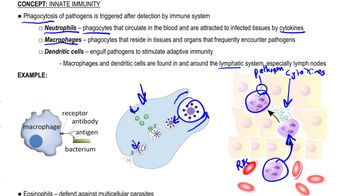
Innate immunity is the body's first line of defense, present at birth and providing immediate, non-specific protection against pathogens. It includes physical barriers like skin and mucous membranes, as well as immune cells that respond quickly to infections. This type of immunity is found in both vertebrates and invertebrates, highlighting its fundamental role in survival.
Recommended video:
Guided course
06:47
Innate Immune Cells

Adaptive Immunity

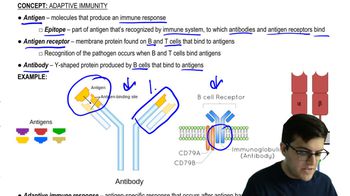
Adaptive immunity develops after exposure to specific pathogens and is characterized by a slower response that improves with subsequent encounters. It is primarily mediated by lymphocytes, including B cells and T cells, which provide targeted responses and memory against specific antigens. This type of immunity is exclusive to vertebrates and is crucial for long-term protection.
Recommended video:
Guided course
05:50
Adaptive Immune Response

Lymphocytes

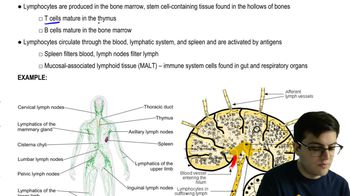
Lymphocytes are a type of white blood cell essential for the immune response, produced in the lymphatic system. They include B cells, which secrete antibodies for the humoral immune response, and T cells, which are responsible for cell-mediated immunity. Lymphocytes play a critical role in recognizing and responding to pathogens, ensuring the body can effectively defend itself against infections.
Recommended video: