Pearson+ LogoPearson+ Logo
Ch. 24 The Immune System
Taylor - Campbell Biology: Concepts & Connections 10th Edition
Taylor, Simon, Dickey, Hogan10th EditionCampbell Biology: Concepts & ConnectionsISBN: 9780136538783Not the one you use?Change textbook
Chapter 24, Problem 5

Cytotoxic T cells are able to recognize infected body cells because
a. The infected cells display foreign antigens.
b. The infected cells produce antigens.
c. Infected cells release antibodies into the blood.
d. Helper T cells destroy them first.

Verified step by step guidance
1
Understand the role of cytotoxic T cells: Cytotoxic T cells (also known as CD8+ T cells) are a type of immune cell that plays a critical role in identifying and destroying infected or abnormal cells in the body. They are part of the adaptive immune system.
Recall how cytotoxic T cells recognize infected cells: Cytotoxic T cells recognize infected cells by detecting foreign antigens presented on the surface of these cells. These antigens are displayed using a protein complex called the major histocompatibility complex class I (MHC-I).
Eliminate incorrect options: (b) is incorrect because infected cells do not produce antigens; instead, they present antigens derived from pathogens. (c) is incorrect because infected cells do not release antibodies; antibodies are produced by B cells. (d) is incorrect because helper T cells do not destroy infected cells; they assist in activating other immune cells.
Focus on the correct mechanism: Infected cells display foreign antigens (derived from pathogens such as viruses or bacteria) on their MHC-I molecules. This allows cytotoxic T cells to recognize and bind to the infected cells.
Conclude the correct answer: Based on the above reasoning, the correct answer is (a) 'the infected cells display foreign antigens,' as this is the mechanism by which cytotoxic T cells identify and target infected cells.

Verified video answer for a similar problem:

This video solution was recommended by our tutors as helpful for the problem above.
Video duration:
1m
Was this helpful?

Key Concepts

Here are the essential concepts you must grasp in order to answer the question correctly.

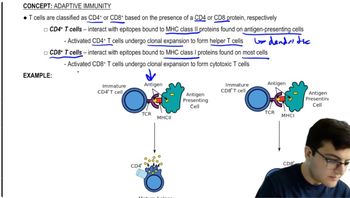
Cytotoxic T Cells

Cytotoxic T cells, also known as CD8+ T cells, are a type of immune cell that play a crucial role in the adaptive immune response. They are responsible for directly killing infected or cancerous cells by recognizing specific antigens presented on the surface of these cells. This recognition is essential for targeting and eliminating cells that pose a threat to the body.
Recommended video:
Guided course
03:43
Antigen Presentation and Cytotoxic T Cells

Antigens

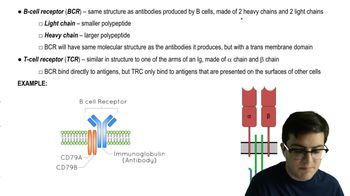
Antigens are molecules or molecular structures that are recognized by the immune system as foreign or non-self. They can be proteins, polysaccharides, or other substances found on the surface of pathogens, such as viruses and bacteria. Infected cells present these foreign antigens on their surface using major histocompatibility complex (MHC) molecules, which are critical for T cell recognition.
Recommended video:
Guided course
03:50
Antigen Receptors

Major Histocompatibility Complex (MHC)

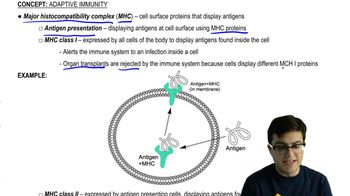
The Major Histocompatibility Complex (MHC) is a set of cell surface proteins essential for the immune system to recognize foreign molecules. MHC class I molecules present antigens from inside the cell, allowing cytotoxic T cells to detect and respond to infected or abnormal cells. This process is vital for initiating an immune response against intracellular pathogens.
Recommended video:
Guided course
04:04
Major Histocompatibility Complex