
Pearson+ LogoPearson+ Logo
Ch. 24 The Immune System
Taylor - Campbell Biology: Concepts & Connections 10th Edition
Taylor, Simon, Dickey, Hogan10th EditionCampbell Biology: Concepts & ConnectionsISBN: 9780136538783Not the one you use?Change textbook
Chapter 24, Problem 8

Helper T cells recognize the self-nonself complex on ___________ cells, while cytotoxic T cells recognize the complex on ___________ cells.

Verified step by step guidance
1
Identify the type of cells that present antigens to Helper T cells. These cells are primarily involved in signaling and activating other immune cells.
Recognize that Helper T cells are crucial for the immune response and they interact with a specific type of cell that processes and presents antigens on major histocompatibility complex (MHC) class II molecules.
Determine the type of cells that present antigens to Cytotoxic T cells. These cells are directly involved in killing virus-infected cells or cells that are otherwise dysfunctional or dangerous to the body.
Understand that Cytotoxic T cells are designed to interact with cells that display antigens on MHC class I molecules, which are found on almost all nucleated cells in the body.
Connect the function of each T cell type with the respective cells they interact with based on the MHC molecule class involved in the presentation of the antigen.

Verified video answer for a similar problem:

This video solution was recommended by our tutors as helpful for the problem above.
Video duration:
4m
Was this helpful?

Key Concepts

Here are the essential concepts you must grasp in order to answer the question correctly.

Helper T Cells

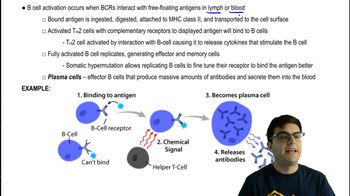
Helper T cells, or CD4+ T cells, play a crucial role in the immune response by recognizing antigens presented by Major Histocompatibility Complex (MHC) class II molecules on antigen-presenting cells (APCs). Once activated, they secrete cytokines that help activate other immune cells, including B cells and cytotoxic T cells, enhancing the overall immune response.
Recommended video:
Guided course
04:06
Helper T Cells and B Cells

Cytotoxic T Cells

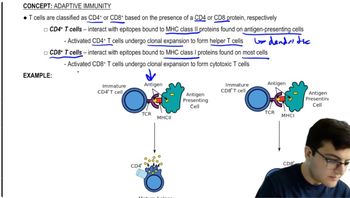
Cytotoxic T cells, or CD8+ T cells, are essential for directly killing infected or cancerous cells. They recognize antigens presented by MHC class I molecules, which are found on nearly all nucleated cells. Upon recognition, cytotoxic T cells release perforins and granzymes that induce apoptosis in the target cells, effectively eliminating the threat.
Recommended video:
Guided course
03:43
Antigen Presentation and Cytotoxic T Cells

Major Histocompatibility Complex (MHC)

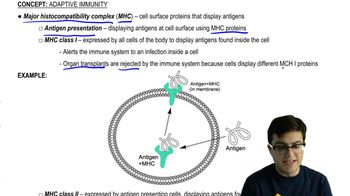
The Major Histocompatibility Complex (MHC) is a set of cell surface proteins essential for the immune system to recognize foreign molecules. MHC class I molecules present endogenous antigens to cytotoxic T cells, while MHC class II molecules present exogenous antigens to helper T cells. This distinction is critical for the adaptive immune response, ensuring that the body can effectively target and eliminate pathogens.
Recommended video:
Guided course
04:04
Major Histocompatibility Complex