Pearson+ LogoPearson+ Logo
Ch. 16 Microbial Life: Prokaryotes and Protists
Taylor - Campbell Biology: Concepts & Connections 10th Edition
Taylor, Simon, Dickey, Hogan10th EditionCampbell Biology: Concepts & ConnectionsISBN: 9780136538783Not the one you use?Change textbook
Chapter 16, Problem 11

The bacteria that cause tetanus can be killed only by prolonged heating at temperatures considerably above boiling. This suggests that tetanus bacteria
a. Have cell walls containing peptidoglycan.
b. Secrete endotoxins.
c. Are autotrophic.
d. Produce endospores.

Verified step by step guidance
1
Understand the problem: The question is asking which characteristic of tetanus bacteria allows them to survive prolonged heating at temperatures above boiling. This requires knowledge of bacterial structures and survival mechanisms.
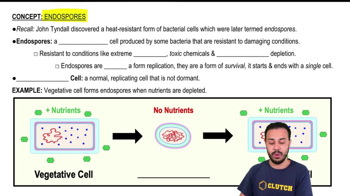
Recall the concept of endospores: Endospores are highly resistant structures formed by certain bacteria to survive extreme conditions, including high temperatures, desiccation, and chemical exposure. This is a key survival mechanism for some bacteria.
Evaluate the options: Analyze each answer choice: (a) Peptidoglycan is a component of bacterial cell walls, but it does not provide resistance to extreme heat. (b) Endotoxins are toxins released by bacteria, but they do not explain heat resistance. (c) Autotrophic bacteria produce their own food, but this is unrelated to heat resistance. (d) Endospores are specifically designed to withstand extreme conditions, including prolonged heating.
Connect the information: Based on the explanation above, the ability to survive prolonged heating is most likely due to the production of endospores, as this is a well-documented survival strategy for certain bacteria, including those that cause tetanus.
Conclude the reasoning: The correct answer is likely (d) because endospores are the only feature listed that directly explains the bacteria's ability to survive prolonged heating at temperatures above boiling.

Verified video answer for a similar problem:

This video solution was recommended by our tutors as helpful for the problem above.
Video duration:
54s
Was this helpful?

Key Concepts

Here are the essential concepts you must grasp in order to answer the question correctly.

Endospores

Endospores are highly resistant structures formed by certain bacteria, allowing them to survive extreme conditions, including high temperatures and desiccation. When environmental conditions become unfavorable, bacteria like Clostridium tetani (the causative agent of tetanus) can form endospores, which can remain dormant for long periods. This resilience explains why prolonged heating is necessary to kill these bacteria.
Recommended video:

Peptidoglycan

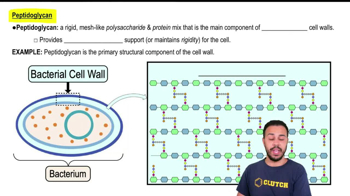
Peptidoglycan is a polymer that forms a protective layer in the cell walls of bacteria, providing structural integrity. While it is a characteristic feature of bacterial cells, the presence of peptidoglycan does not directly relate to the heat resistance of tetanus bacteria. Instead, it is more relevant to the classification of bacteria as Gram-positive or Gram-negative.
Recommended video:
Guided course
01:58
Peptidoglycan

Autotrophic vs. Heterotrophic

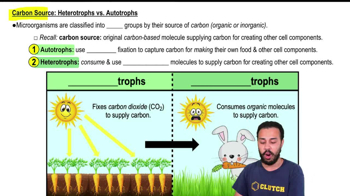
Autotrophic organisms can produce their own food from inorganic substances, while heterotrophic organisms rely on consuming organic material. Tetanus bacteria, being heterotrophic, obtain nutrients from their environment, typically from the host's tissues. This distinction is important for understanding bacterial metabolism but does not explain the heat resistance of tetanus bacteria.
Recommended video:
Guided course
02:59
Carbon Source: Heterotrophs vs. Autotrophs
Related Practice
Textbook Question
Explain why prokaryote populations can adapt rapidly to changes in their environment.
1227
views
Textbook Question

What characteristic distinguishes true multicellularity from colonies of cells?

2411
views
2
rank
Textbook Question

Chlamydomonas is a unicellular green alga. How does it differ from a photosynthetic bacterium, which is also single-celled? How does it differ from a protozoan, such as an amoeba? How does it differ from larger green algae, such as sea lettuce (Ulva)?

1569
views
Textbook Question

Which of the following experiments could test the hypothesis that bacteria cause ulcers in humans? (Assume each experiment includes a control group.) Explain what evidence would be provided by the results of the experiment.

a. Identify the microbes found in the stomachs of ulcer patients.

b. Treat a group of ulcer patients with antibiotics.

c. Place a group of ulcer patients on a strict low-acid diet.

d. Obtain stomach fluid from ulcer patents and feed it to mice.

932
views
Textbook Question

In a process known as 'coral bleaching,' high water temperatures cause corals to expel the dinoflagellates that normally reside within their cells. How might coral bleaching affect coral reefs?

1529
views
Textbook Question

Probiotics, foods and supplements that contain living microorganisms, are thought to cure problems of the digestive tract by restoring the natural balance of its microbial community. Sales of these products total billions of dollars a year. Explore the topic of probiotics and evaluate the scientific evidence for their beneficial effects. A good starting point is the website of the U.S. Food and Drug Administration, which regulates advertising claims of health benefits of dietary supplements. U.S. Food and Drug Administration website, www.fda.gov/food/dietary-supplements.

935
views