
Chlamydomonas is a unicellular green alga. How does it differ from a photosynthetic bacterium, which is also single-celled? How does it differ from a protozoan, such as an amoeba? How does it differ from larger green algae, such as sea lettuce (Ulva)?
Taylor, Simon, Dickey, Hogan 10th Edition
Ch. 16 Microbial Life: Prokaryotes and Protists
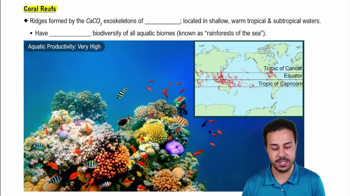
Problem 13In a process known as 'coral bleaching,' high water temperatures cause corals to expel the dinoflagellates that normally reside within their cells. How might coral bleaching affect coral reefs?
Verified step by step guidance
Verified video answer for a similar problem:
Key Concepts
Coral Symbiosis
Coral Bleaching
Ecosystem Impact
The bacteria that cause tetanus can be killed only by prolonged heating at temperatures considerably above boiling. This suggests that tetanus bacteria
a. Have cell walls containing peptidoglycan.
b. Secrete endotoxins.
c. Are autotrophic.
d. Produce endospores.
Which of the following experiments could test the hypothesis that bacteria cause ulcers in humans? (Assume each experiment includes a control group.) Explain what evidence would be provided by the results of the experiment.
a. Identify the microbes found in the stomachs of ulcer patients.
b. Treat a group of ulcer patients with antibiotics.
c. Place a group of ulcer patients on a strict low-acid diet.
d. Obtain stomach fluid from ulcer patents and feed it to mice.
Probiotics, foods and supplements that contain living microorganisms, are thought to cure problems of the digestive tract by restoring the natural balance of its microbial community. Sales of these products total billions of dollars a year. Explore the topic of probiotics and evaluate the scientific evidence for their beneficial effects. A good starting point is the website of the U.S. Food and Drug Administration, which regulates advertising claims of health benefits of dietary supplements. U.S. Food and Drug Administration website, www.fda.gov/food/dietary-supplements.
The buildup of CO2 in the atmosphere resulting from the burning of fossil fuels is regarded as a major contributor to global warming. Diatoms and other microscopic algae in the oceans counter this buildup by using large quantities of atmospheric CO2 in photosynthesis, which requires small quantities of iron. Experts suspect that a shortage of iron may limit algal growth in the oceans. Some scientists have suggested that one way to reduce CO2 buildup might be to fertilize the oceans with iron. The iron would stimulate algal growth and thus the removal of more CO2 from the air. A single supertanker of iron dust, spread over a wide enough area, might reduce the atmospheric CO2 level significantly. Do you think this approach would be worth a try? Why or why not?