Pearson+ LogoPearson+ Logo
Ch. 28 Nervous Systems
Taylor - Campbell Biology: Concepts & Connections 10th Edition
Taylor, Simon, Dickey, Hogan10th EditionCampbell Biology: Concepts & ConnectionsISBN: 9780136538783Not the one you use?Change textbook
Chapter 28, Problem 9

Using microelectrodes, a researcher recorded nerve signals in four neurons in the brain of a snail, called A, B, C, and D in the table below. A, B, and C can all transmit signals to D. In three experiments, the animal was stimulated in different ways. The number of nerve signals transmitted per second by each of the cells is recorded in the table. Write a short paragraph explaining the different results of the three experiments. Table showing nerve signals per second from neurons A, B, C to D across three experiments.

Verified step by step guidance
1
Analyze the table to understand the number of signals transmitted per second by neurons A, B, C, and D in each experiment.
Observe that in Experiment #1, neurons A and C are active, while B is inactive, resulting in neuron D receiving 30 signals per second.
Note that in Experiment #2, neurons A and C are still active, but C transmits more signals (60 signals/sec), leading to neuron D receiving 45 signals per second.
In Experiment #3, all three neurons A, B, and C are active, but neuron D does not receive any signals, indicating a possible inhibitory effect from neuron B.
Summarize the findings by explaining how the different combinations of active neurons (A, B, and C) affect the signal reception in neuron D across the three experiments.

Verified video answer for a similar problem:

This video solution was recommended by our tutors as helpful for the problem above.
Video duration:
1m
Was this helpful?

Key Concepts

Here are the essential concepts you must grasp in order to answer the question correctly.

Neuronal Communication

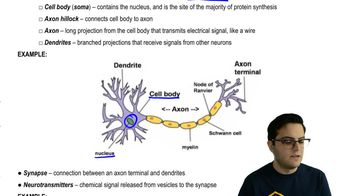
Neuronal communication refers to the process by which neurons transmit signals to one another through synapses. This involves the release of neurotransmitters from the presynaptic neuron, which bind to receptors on the postsynaptic neuron, leading to the generation of action potentials. Understanding this concept is crucial for interpreting how different neurons (A, B, C) influence the activity of neuron D in the experiments.
Recommended video:

Signal Transmission Rate

The signal transmission rate, measured in signals per second, indicates how frequently a neuron can send action potentials. In the context of the experiments, the varying rates of signals from neurons A, B, and C to neuron D highlight how different stimulation methods affect neuronal output. Analyzing these rates helps explain the differences in D's response across the three experiments.
Recommended video:
Guided course
06:10
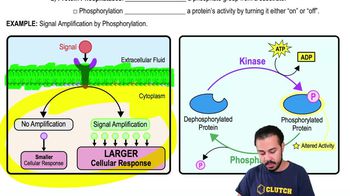
Signal Amplification

Experimental Design

Experimental design involves planning how to conduct an experiment to test a hypothesis effectively. In this case, the design includes varying the stimulation of neurons A, B, and C to observe their effects on neuron D. Understanding the design helps in interpreting the results, as it clarifies how changes in stimulation correlate with the observed nerve signal outputs.
Recommended video:
Guided course
02:50
Experimental Design Example 1