
Pearson+ LogoPearson+ Logo
Ch. 28 Nervous Systems
Taylor - Campbell Biology: Concepts & Connections 10th Edition
Taylor, Simon, Dickey, Hogan10th EditionCampbell Biology: Concepts & ConnectionsISBN: 9780136538783Not the one you use?Change textbook
Chapter 28, Problem 7

Anesthetics block pain by blocking the transmission of nerve signals. Which of these three chemicals might work as anesthetics? (Choose all that apply and explain your selections.)
a. A chemical that prevents the opening of voltage-gated Na+ channels in membranes
b. A chemical that inhibits the enzymes that degrade neurotransmitters
c. A chemical that blocks neurotransmitter receptors

Verified step by step guidance
1
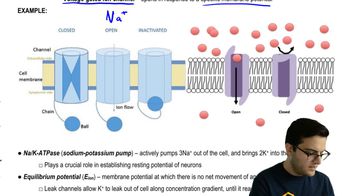
Step 1: Understand the role of voltage-gated Na⁺ channels in nerve signal transmission. These channels are essential for the initiation and propagation of action potentials in neurons. If a chemical prevents the opening of these channels, it would stop the nerve signal from being transmitted, effectively blocking pain perception. This could make such a chemical a potential anesthetic.
Step 2: Analyze the role of enzymes that degrade neurotransmitters. These enzymes are responsible for breaking down neurotransmitters in the synaptic cleft, ensuring that the signal does not persist longer than necessary. If a chemical inhibits these enzymes, it would prolong the presence of neurotransmitters in the synapse, potentially leading to overstimulation of the postsynaptic neuron rather than blocking pain. This mechanism is unlikely to work as an anesthetic.
Step 3: Examine the function of neurotransmitter receptors. These receptors are located on the postsynaptic membrane and are responsible for receiving signals from neurotransmitters. If a chemical blocks these receptors, it would prevent the postsynaptic neuron from receiving the signal, effectively interrupting the transmission of nerve signals and potentially acting as an anesthetic.
Step 4: Compare the mechanisms of the three chemicals. Based on the analysis, chemicals that prevent the opening of voltage-gated Na⁺ channels (option a) and those that block neurotransmitter receptors (option c) are likely to work as anesthetics because they directly interfere with the transmission of nerve signals.
Step 5: Conclude that option b, which inhibits enzymes that degrade neurotransmitters, is unlikely to work as an anesthetic because it does not block nerve signal transmission but rather prolongs it, which could lead to increased neural activity instead of pain relief.

Verified video answer for a similar problem:

This video solution was recommended by our tutors as helpful for the problem above.
Video duration:
3m
Was this helpful?

Key Concepts

Here are the essential concepts you must grasp in order to answer the question correctly.

Voltage-Gated Sodium Channels

Voltage-gated sodium channels are integral membrane proteins that open in response to changes in membrane potential, allowing Na+ ions to flow into the neuron. This influx is crucial for the generation and propagation of action potentials, which are essential for nerve signal transmission. Anesthetics that prevent the opening of these channels can effectively block pain signals by inhibiting action potential generation.
Recommended video:
Guided course
08:38
Ion Channels and Pumps

Neurotransmitter Degradation

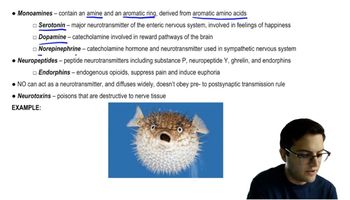
Neurotransmitter degradation involves the breakdown of neurotransmitters in the synaptic cleft, which is essential for terminating the signal between neurons. Enzymes such as acetylcholinesterase degrade neurotransmitters like acetylcholine. A chemical that inhibits these enzymes would prolong the action of neurotransmitters, potentially leading to increased signaling rather than blocking pain, making it less effective as an anesthetic.
Recommended video:
Guided course
12:47
Neurotransmitters

Neurotransmitter Receptors

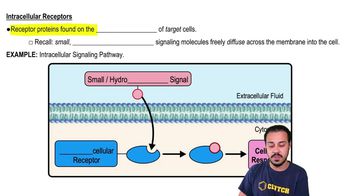
Neurotransmitter receptors are proteins located on the postsynaptic membrane that bind neurotransmitters and mediate their effects on the neuron. Blocking these receptors prevents neurotransmitters from exerting their effects, which can inhibit pain transmission. Therefore, a chemical that blocks neurotransmitter receptors can serve as an effective anesthetic by preventing the propagation of pain signals.
Recommended video:
Guided course
02:28
Intracellular Receptors
Related Practice
Textbook Question
What causes a nerve signal to move from one end of a neuron along the length of the neuron to the other end? What is a nerve signal, exactly? Why can't it go backward? How is a nerve signal transmitted from one neuron to the next across a synapse? Write a short paragraph that answers these questions.
1094
views
Textbook Question

Joe accidentally touched a hot pan. His arm jerked back, and an instant later, he felt a burning pain. How would you explain the fact that his arm moved before he felt the pain?

a. His limbic system blocked the pain momentarily, but the important pain signals eventually got through.

b. His response was a spinal cord reflex that occurred before the pain signals reached the brain.

c. Motor neurons are myelinated; sensory neurons are not. The signals traveled faster to his muscles.

d. This scenario is not actually possible. The brain must register pain before a person can react.

1025
views
Textbook Question

Which division of the autonomic nervous system would you expect to be activated if a person heard an intruder at the front door?

a. Parasympathetic

b. Sympathetic

c. Enteric

1291
views
Textbook Question

A proposal to test an SSRI in a large number of individuals with depression was submitted to the FDA. Through random assignments, half of the patients would be controls, receiving nothing at all, and half the patients would receive the drug in pill form. Patients in both groups would note changes in their own mood in a daily journal. What flaw(s) do you note in this experimental design?

811
views
Textbook Question
Using microelectrodes, a researcher recorded nerve signals in four neurons in the brain of a snail, called A, B, C, and D in the table below. A, B, and C can all transmit signals to D. In three experiments, the animal was stimulated in different ways. The number of nerve signals transmitted per second by each of the cells is recorded in the table. Write a short paragraph explaining the different results of the three experiments.

1138
views
Textbook Question
Design an experiment with a group of taxi drivers in a new city to examine the role of neuroplasticity on learning. Assume you have the ability to image their brains to measure changes in the volume of gray matter.
702
views