Pearson+ LogoPearson+ Logo
Ch. 27 Reproduction and Embryonic Development
Taylor - Campbell Biology: Concepts & Connections 10th Edition
Taylor, Simon, Dickey, Hogan10th EditionCampbell Biology: Concepts & ConnectionsISBN: 9780136538783Not the one you use?Change textbook
Chapter 27, Problem 16

In an embryo, nerve cells grow out from the spinal cord and form connections with the muscles they will eventually control. What mechanisms described in this chapter might explain how these cells 'know' where to go and which cells to connect with?

Verified step by step guidance
1
Understand the role of chemical signals: Nerve cells, or neurons, use chemical signals to guide their growth towards their target muscles. These chemicals, known as growth factors, create a gradient that the growing axons of the neurons follow.
Learn about growth cones: The tips of the growing axons are equipped with structures called growth cones. These cones are highly sensitive to the chemical signals in their environment and steer the axon in the right direction by extending and retracting their filopodia (finger-like projections).
Explore cell adhesion molecules (CAMs): CAMs on the surface of neurons and target muscle cells help in the recognition and stable connection between the nerve cell and its target. These molecules ensure that the connections are specific and that each neuron connects with the correct muscle.
Consider the role of synaptic pruning: After the initial connections are made, synaptic pruning occurs where excess neurons and synaptic connections are eliminated. This process refines the connections to ensure that they are efficient and precise.
Examine neural maps: Neural maps are formed in the brain and spinal cord, which represent the spatial arrangement of the body's muscles. These maps guide the neurons to their corresponding muscle targets, ensuring proper coordination and function.

Verified video answer for a similar problem:

This video solution was recommended by our tutors as helpful for the problem above.
Video duration:
2m
Was this helpful?

Key Concepts

Here are the essential concepts you must grasp in order to answer the question correctly.

Neuronal Guidance

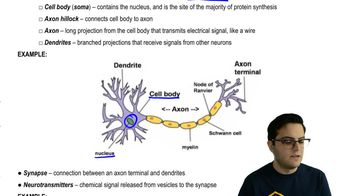
Neuronal guidance refers to the processes by which developing nerve cells (neurons) navigate to their target locations in the body. This involves the use of molecular cues, such as guidance molecules and growth factors, that direct the growth of axons and dendrites towards specific target cells, ensuring proper connections are formed.
Recommended video:

Synaptogenesis

Synaptogenesis is the formation of synapses between neurons during development. This process is crucial for establishing functional neural circuits, as it involves the precise matching of pre- and post-synaptic cells. Factors such as cell adhesion molecules and neurotransmitter receptors play significant roles in determining which neurons connect with each other.

Neurotrophic Factors

Neurotrophic factors are proteins that support the growth, survival, and differentiation of neurons. They are essential for guiding neurons to their targets and promoting synaptic connections. Examples include nerve growth factor (NGF) and brain-derived neurotrophic factor (BDNF), which help neurons respond to environmental cues and establish functional networks.
Recommended video:
Guided course
01:39
Density-Independent Factors
Related Practice
Textbook Question

A woman had several miscarriages. Her doctor suspected that a hormonal insufficiency was causing the lining of the uterus to break down, as it does during menstruation, terminating her pregnancies. Treatment with which of the following might help her remain pregnant?

a. Oxytocin

b. Follicle-stimulating hormone

c. Luteinizing hormone

d. Prolactin

1285
views
Textbook Question
The embryos of reptiles (including birds) and mammals have systems of extraembryonic membranes. What are the functions of these membranes, and how do fish and frog embryos survive without them?
1133
views
Textbook Question
Compare sperm formation with egg formation. In what ways are the processes similar? In what ways are they different?
1310
views
Textbook Question
As a frog embryo develops, the neural tube forms from ectoderm along what will be the frog's back, directly above the notochord. To study this process, a researcher extracted a bit of notochord tissue and inserted it under the ectoderm where the frog's belly would normally develop. What can the researcher hope to learn from this experiment? Predict the possible outcomes. What experimental control would you suggest?
1433
views
Textbook Question

Should parents undergoing in vitro fertilization have the right to choose which embryos to implant based on genetic criteria, such as the presence or absence of disease-causing genes? Should they be able to choose based on the sex of the embryo? How could you distinguish acceptable from unacceptable criteria? Do you think such options should be legislated?

962
views
Textbook Question

There are difficulties inherent in testing hypotheses involving human health. Imagine that you have ­developed a potential vaccine against AIDS. Given the nature of the disease, all testing must be conducted in humans. Can you ­design an ethical but effective experiment?

716
views