
Pearson+ LogoPearson+ Logo
Ch. 27 Reproduction and Embryonic Development
Taylor - Campbell Biology: Concepts & Connections 10th Edition
Taylor, Simon, Dickey, Hogan10th EditionCampbell Biology: Concepts & ConnectionsISBN: 9780136538783Not the one you use?Change textbook
Chapter 27, Problem 2

Match each function with the correct structure.


2. Turns into the corpus luteum
3. Female gonad
4. Site of spermatogenesis
5. Site of fertilization in humans
6. Site of human gestation
7. Sperm duct
8. Secretes seminal fluid
9. Lining of uterus


a. vas deferens
b. prostate gland
c. endometrium
d. testis
e. follicle
f. uterus
g. ovary
h. oviduct

Verified step by step guidance
1
Step 1: Understand the question. The problem asks you to match each function (2-9) with the correct structure (a-h). Each function describes a biological process or location, and each structure corresponds to a specific anatomical feature in the human reproductive system.
Step 2: Analyze each function and recall the relevant biological concepts: - For function 2 ('Turns into the corpus luteum'), recall that the corpus luteum forms from a follicle after ovulation. - For function 3 ('Female gonad'), remember that gonads are organs that produce gametes, and in females, this is the ovary. - For function 4 ('Site of spermatogenesis'), recall that spermatogenesis occurs in the testis. - For function 5 ('Site of fertilization in humans'), fertilization typically occurs in the oviduct (fallopian tube). - For function 6 ('Site of human gestation'), gestation occurs in the uterus. - For function 7 ('Sperm duct'), the vas deferens is the duct that transports sperm. - For function 8 ('Secretes seminal fluid'), the prostate gland is one of the structures that secretes seminal fluid. - For function 9 ('Lining of uterus'), the endometrium is the inner lining of the uterus.
Step 3: Match each function with the correct structure based on the analysis: - Function 2 matches with 'e. follicle'. - Function 3 matches with 'g. ovary'. - Function 4 matches with 'd. testis'. - Function 5 matches with 'h. oviduct'. - Function 6 matches with 'f. uterus'. - Function 7 matches with 'a. vas deferens'. - Function 8 matches with 'b. prostate gland'. - Function 9 matches with 'c. endometrium'.
Step 4: Double-check your matches to ensure they align with the biological functions and structures. For example, confirm that the corpus luteum forms from a follicle, the ovary is the female gonad, and so on.
Step 5: Write down the final matches in a clear and organized manner for reference. Ensure that each function is paired with the correct structure as determined in the previous steps.

Verified video answer for a similar problem:

This video solution was recommended by our tutors as helpful for the problem above.
Video duration:
38s
Was this helpful?

Key Concepts

Here are the essential concepts you must grasp in order to answer the question correctly.

Reproductive Anatomy

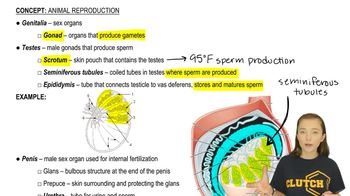
Reproductive anatomy refers to the structures involved in the reproductive system of both males and females. In females, key structures include the ovaries, which produce eggs, and the uterus, where gestation occurs. In males, the testis is responsible for sperm production, while the vas deferens transports sperm. Understanding these structures is essential for matching functions to their corresponding anatomical parts.
Recommended video:
Guided course
11:56
Male Reproductive Anatomy

Gonadal Function

Gonadal function encompasses the roles of the ovaries and testes in producing gametes (eggs and sperm) and hormones. The ovaries produce follicles that develop into eggs and secrete hormones like estrogen, while the testes produce sperm and testosterone. Recognizing these functions is crucial for identifying which structures correspond to specific reproductive roles in the question.
Recommended video:
Guided course
06:04
Functional Groups

Fertilization and Gestation

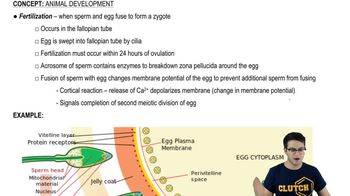
Fertilization is the process where a sperm cell unites with an egg, typically occurring in the oviduct (fallopian tube) in humans. Following fertilization, the fertilized egg implants in the uterus, where gestation takes place. Understanding these processes is vital for accurately matching the sites of fertilization and gestation to their respective anatomical structures.
Recommended video:
Guided course
01:59
Fertilization