
Pearson+ LogoPearson+ Logo
Ch. 27 Reproduction and Embryonic Development
Taylor - Campbell Biology: Concepts & Connections 10th Edition
Taylor, Simon, Dickey, Hogan10th EditionCampbell Biology: Concepts & ConnectionsISBN: 9780136538783Not the one you use?Change textbook
Chapter 27, Problem 1

This graph plots the rise and fall of pituitary and ovarian hormones during the human ovarian cycle. Identify each hormone (A–D) and the reproductive events with which each one is associated (P–S). For A–D, choose from estrogen, LH, FSH, and progesterone. For P–S, choose from ovulation, growth of follicle, menstruation, and development of corpus luteum. How would the right-hand side of this graph be altered if pregnancy occurred? What other hormone is responsible for triggering this change? Graph showing hormone levels during the human ovarian cycle with events labeled P-S.

Verified step by step guidance
1
Identify the four hormones (A-D) based on their patterns in the graph. Note that LH (Luteinizing Hormone) typically has a sharp peak around day 14, FSH (Follicle Stimulating Hormone) has a smaller peak around the same time, estrogen rises before ovulation and has a smaller peak after, and progesterone rises after ovulation and remains high if pregnancy occurs.
Match the events (P-S) with the corresponding days and hormone levels. Ovulation (R) occurs around day 14, growth of the follicle (Q) happens before ovulation, menstruation (P) occurs at the beginning of the cycle, and development of the corpus luteum (S) happens after ovulation.
Determine how the right-hand side of the graph would change if pregnancy occurred. Progesterone levels (D) would remain high instead of dropping.
Identify the hormone responsible for maintaining high progesterone levels during pregnancy. This hormone is hCG (human chorionic gonadotropin).
Summarize the changes and the role of hCG in maintaining the corpus luteum and progesterone levels during pregnancy.

Verified video answer for a similar problem:

This video solution was recommended by our tutors as helpful for the problem above.
Video duration:
44s
Was this helpful?

Key Concepts

Here are the essential concepts you must grasp in order to answer the question correctly.

Ovarian Cycle

The ovarian cycle consists of a series of hormonal changes that regulate the development and release of eggs from the ovaries. It typically lasts about 28 days and includes phases such as the follicular phase, ovulation, and the luteal phase. Understanding this cycle is crucial for interpreting hormone levels and their associated reproductive events.
Recommended video:

Hormonal Regulation

Hormones such as estrogen, LH (luteinizing hormone), FSH (follicle-stimulating hormone), and progesterone play vital roles in regulating the ovarian cycle. For instance, LH triggers ovulation, while FSH promotes follicle growth. The interplay of these hormones is essential for the timing of reproductive events and understanding the graph's fluctuations.
Recommended video:
Guided course
08:18
Plant Hormones and Senescence

Pregnancy and Hormonal Changes

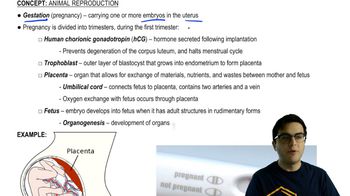
If pregnancy occurs, the levels of certain hormones, particularly progesterone, increase significantly to maintain the uterine lining and support the developing embryo. Human chorionic gonadotropin (hCG) is the hormone responsible for signaling the corpus luteum to continue producing progesterone, altering the expected hormonal patterns seen in the ovarian cycle.
Recommended video:
Guided course
04:09
Pregnancy and Birth