Pearson+ LogoPearson+ Logo
Ch. 4 A Tour of the Cell
Taylor - Campbell Biology: Concepts & Connections 10th Edition
Taylor, Simon, Dickey, Hogan10th EditionCampbell Biology: Concepts & ConnectionsISBN: 9780136538783Not the one you use?Change textbook
Chapter 4, Problem 17

How might the phrase 'ingested but not digested' be used in a description of the endosymbiotic theory?

Verified step by step guidance
1
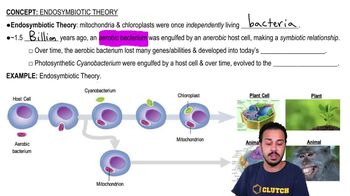
Understand the concept of the endosymbiotic theory: This theory suggests that some organelles within eukaryotic cells, such as mitochondria and chloroplasts, were once independent prokaryotic organisms that were taken inside a larger host cell through a process called endocytosis.
Examine the phrase 'ingested but not digested': In the context of the endosymbiotic theory, 'ingested' refers to the process where the larger host cell takes in the smaller prokaryotic organisms. 'Not digested' implies that instead of being broken down and used as food, these organisms survived inside the host cell.
Explore the mutual benefits: After being ingested, the prokaryotic organisms provided essential functions for the host cell, such as energy production in the case of mitochondria, or photosynthesis in the case of chloroplasts. In return, they received protection and access to nutrients, allowing them to thrive inside the host.
Discuss the evolution into organelles: Over time, these ingested prokaryotes became permanent residents of the host cell, evolving into organelles. This process involved the transfer of some of their genes to the host cell's nucleus, a key aspect of their integration and the development of the eukaryotic cell.
Reflect on the significance of this relationship: The phrase 'ingested but not digested' highlights the crucial step in the endosymbiotic theory where the host cell and the prokaryotic organisms formed a symbiotic relationship, leading to significant evolutionary advancements in the formation of complex life forms.

Verified video answer for a similar problem:

This video solution was recommended by our tutors as helpful for the problem above.
Video duration:
1m
Was this helpful?

Key Concepts

Here are the essential concepts you must grasp in order to answer the question correctly.

Endosymbiotic Theory

The endosymbiotic theory posits that certain organelles, particularly mitochondria and chloroplasts, originated as free-living prokaryotes that were engulfed by ancestral eukaryotic cells. This theory explains the dual genetic origins of these organelles, as they contain their own DNA, which is similar to bacterial DNA, supporting the idea of a symbiotic relationship that evolved over time.
Recommended video:
Guided course
06:58
Endosymbiotic Theory

Ingestion vs. Digestion

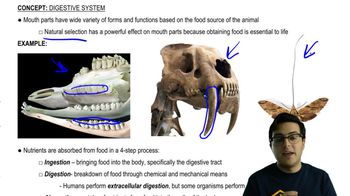
In biological terms, ingestion refers to the process of taking in substances, while digestion involves breaking down those substances into usable forms. The phrase 'ingested but not digested' suggests that certain elements, such as prokaryotic cells, were taken up by a host cell but were not fully broken down, allowing them to persist and eventually contribute to the host's cellular functions.
Recommended video:
Guided course
05:11
Digestion and Digestive Tracts

Symbiosis

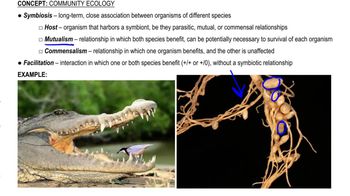
Symbiosis is a biological term describing the interaction between two different organisms living in close physical proximity, often to the benefit of both. In the context of the endosymbiotic theory, the relationship between the engulfed prokaryotes and the host eukaryotic cell exemplifies mutualistic symbiosis, where both parties gain advantages, such as enhanced energy production for the host and protection for the engulfed cells.
Recommended video:
Related Practice
Textbook Question
Describe the structure of the plasma membrane of an animal cell. What would be found directly inside and outside the membrane?
2300
views
Textbook Question

Imagine a spherical cell with a radius of 10 μm. What is the cell's surface area in μm²?

Its volume, in μm³? (Note: For a sphere of radius r, surface area = 4πr² and volume = 4/3πr³.). Remember that the value of π is 3.14.)

What is the ratio of surface area to volume for this cell? Now do the same calculations for a second cell, this one with a radius of 20 μm. Compare the surface-to-volume ratios of the two cells.

How is this comparison significant to the functioning of cells?

2512
views
Textbook Question
Describe the pathway of the protein hormone insulin from its gene to its export from a cell of your pancreas.
1993
views
Textbook Question
Cilia are found on cells in almost every organ of the human body, and the malfunction of cilia is involved in several human disorders. During embryological development, for example, cilia generate a leftward flow of fluid that initiates the left-right organization of the body organs. Some individuals with primary ciliary dyskinesia exhibit a condition (situs inversus) in which internal organs such as the heart are on the wrong side of the body. Explain why this reversed arrangement may be a symptom of PCD.
2325
views
1
rank
Textbook Question

Microtubules often produce movement through their interaction with motor proteins. But in some cases, microtubules move cell components when the length of the microtubule changes. Through a series of experiments, researchers determined that microtubules grow and shorten as tubulin proteins are added or removed from their ends. Other experiments showed that microtubules make up the spindle apparatus that 'pulls' chromosomes toward opposite ends (poles) of a dividing cell. The figures below describe a clever experiment done in 1987 to determine whether a spindle microtubule shortens (depolymerizes) at the end holding a chromosome or at the pole end of a dividing cell. Experimenters labeled the microtubules of a dividing cell from a pig kidney with a yellow fluorescent dye. As shown on the left half of the diagram below, they then marked a region halfway along the microtubules by using a laser to eliminate the fluorescence from that region. They did not mark the other side of the spindle (right side of the figure).

1894
views
Textbook Question

The figure below illustrates the results they observed as the chromosomes moved toward the opposite poles of the cell. Describe these results.

What would you conclude about where the microtubules depolymerize from comparing the length of the microtubules on either side of the mark?

How could the experimenters determine whether this is the mechanism of chromosome movement in all cells?

1491
views