
Pearson+ LogoPearson+ Logo
Ch. 4 A Tour of the Cell
Taylor - Campbell Biology: Concepts & Connections 10th Edition
Taylor, Simon, Dickey, Hogan10th EditionCampbell Biology: Concepts & ConnectionsISBN: 9780136538783Not the one you use?Change textbook
Chapter 4, Problem 14

Describe the structure of the plasma membrane of an animal cell. What would be found directly inside and outside the membrane?

Verified step by step guidance
1
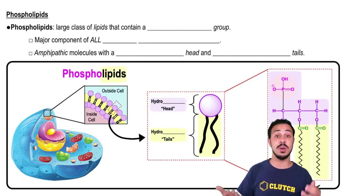
Identify the main components of the plasma membrane: The plasma membrane primarily consists of a phospholipid bilayer, proteins, cholesterol, and carbohydrates. The phospholipid bilayer forms the basic structure, with hydrophilic (water-attracting) heads facing outward and hydrophobic (water-repelling) tails facing inward, creating a barrier that regulates entry and exit of substances.
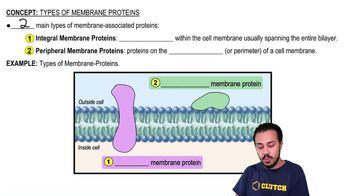
Examine the role of proteins in the membrane: Proteins in the plasma membrane can be integral (spanning the membrane) or peripheral (attached to the surface). These proteins are crucial for various functions such as transport, signal transduction, and cell recognition.
Discuss the function of cholesterol in the membrane: Cholesterol is interspersed within the phospholipid bilayer. It helps to stabilize the membrane's fluidity, making it less permeable to very small water-soluble molecules that might otherwise freely pass through.
Describe the carbohydrates in the membrane: Carbohydrates are typically attached to proteins (forming glycoproteins) or lipids (forming glycolipids). These structures are mainly found on the outer surface of the plasma membrane and play a key role in cell-cell recognition and communication.
Explain what is found inside and outside the plasma membrane: Directly inside the plasma membrane, you would find the cytoplasm of the cell, which includes the cytosol (the fluid part) and various organelles. Outside the plasma membrane, there is the extracellular fluid, which includes various ions, nutrients, and signaling molecules necessary for the cell's interaction with its environment.

Verified video answer for a similar problem:

This video solution was recommended by our tutors as helpful for the problem above.
Video duration:
1m
Was this helpful?

Key Concepts

Here are the essential concepts you must grasp in order to answer the question correctly.

Phospholipid Bilayer

The plasma membrane is primarily composed of a phospholipid bilayer, which consists of two layers of phospholipid molecules. Each phospholipid has a hydrophilic (water-attracting) 'head' and two hydrophobic (water-repelling) 'tails.' This arrangement allows the membrane to be fluid and flexible, creating a barrier that separates the internal environment of the cell from the external surroundings.
Recommended video:
Guided course
04:05
Phospholipids

Membrane Proteins

Embedded within the phospholipid bilayer are various proteins that serve multiple functions, including transport, signaling, and structural support. These membrane proteins can be integral (spanning the membrane) or peripheral (attached to the surface). They play crucial roles in facilitating communication between the cell and its environment, as well as in the transport of substances across the membrane.
Recommended video:
Guided course
02:35
Types of Membrane Proteins

Extracellular and Intracellular Environments

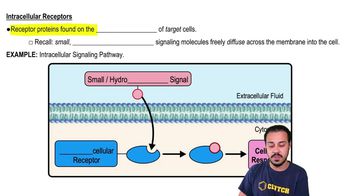
The regions outside the plasma membrane are referred to as the extracellular environment, which contains various substances such as nutrients, signaling molecules, and ions. Conversely, the intracellular environment is the area within the cell, filled with cytoplasm and organelles. Understanding the composition and dynamics of these environments is essential for grasping how cells interact with their surroundings and maintain homeostasis.
Recommended video:
Guided course
02:28
Intracellular Receptors