Pearson+ LogoPearson+ Logo
Ch. 19 The Evolution of Vertebrate Diversity
Taylor - Campbell Biology: Concepts & Connections 10th Edition
Taylor, Simon, Dickey, Hogan10th EditionCampbell Biology: Concepts & ConnectionsISBN: 9780136538783Not the one you use?Change textbook
Chapter 19, Problem 17

Anthropologists are interested in locating areas in Africa where fossils 4–8 million years old might be found. Why?

Verified step by step guidance
1
Understand the significance of the time period: The time frame of 4–8 million years ago is crucial because it marks a pivotal period in human evolution. This is when many scientists believe that the earliest hominins, or human ancestors, began to diverge from other primates.
Recognize the importance of fossils: Fossils from this period can provide critical insights into the physical characteristics, environments, and behaviors of early human ancestors. These fossils help anthropologists understand how early hominins adapted to their environments, what they ate, and how they moved.
Identify the relevance of Africa: Africa is widely considered the 'cradle of humankind' because it has yielded some of the oldest and most complete fossils of early humans. The continent's diverse climates and ecological systems provide a rich archive of evolutionary history.
Connect the dots between fossil locations and evolutionary theories: By locating and studying fossils from 4–8 million years ago in Africa, anthropologists can test and refine their theories about human evolution. Each new discovery has the potential to reshape our understanding of how modern humans evolved.
Highlight the interdisciplinary approach: Finding and analyzing these fossils involves a combination of geology, biology, and anthropology. Understanding the geological context helps researchers determine the age of the fossils, while biological studies can reveal details about the diet and health of these early humans.

Verified video answer for a similar problem:

This video solution was recommended by our tutors as helpful for the problem above.
Video duration:
2m
Was this helpful?

Key Concepts

Here are the essential concepts you must grasp in order to answer the question correctly.

Fossil Record

The fossil record is a historical archive of biological life on Earth, preserved in sedimentary rocks. It provides crucial evidence of the evolution of species over millions of years, including the emergence of hominins. By studying fossils, anthropologists can trace the physical and behavioral changes in early human ancestors, which is essential for understanding human evolution.
Recommended video:
03:17
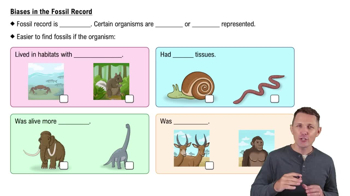
Biases in the Fossil Record

Hominin Evolution

Hominin evolution refers to the evolutionary process that led to the emergence of modern humans and their ancestors. This period, particularly between 4 to 8 million years ago, is significant as it marks the divergence of the human lineage from other primates. Understanding this evolution helps anthropologists identify key adaptations, such as bipedalism and tool use, that shaped human development.
Recommended video:
05:14
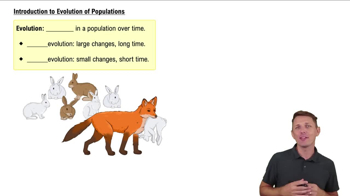
Introduction to Evolution of Populations

Geological Context

The geological context involves understanding the age, formation, and location of rock layers where fossils are found. Different geological strata can provide insights into the environmental conditions of the past, which are crucial for interpreting the habitat and lifestyle of ancient species. Identifying areas in Africa with the right geological conditions helps anthropologists locate potential fossil sites that could yield important discoveries.
Recommended video:
04:22
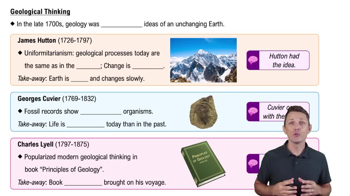
Geological Thinking