Pearson+ LogoPearson+ Logo
Ch. 13 - Meiosis
Freeman - Biological Science 7th Edition
Freeman7th EditionBiological ScienceISBN: 9783584863285Not the one you use?Change textbook
Chapter 13, Problem 6

If you followed a woman's cells through meiosis, at what stage of meiosis would the amount of DNA in one of these cells be equal to the amount of DNA in one of her G1 phase (before DNA replication) kidney cells?

Verified step by step guidance
1
Understand the stages of meiosis: Meiosis consists of two consecutive divisions, meiosis I and meiosis II, each with prophase, metaphase, anaphase, and telophase stages.
Recognize that during the G1 phase of the cell cycle, cells have a diploid amount of DNA, which has not yet been replicated.
Recall that DNA replication occurs during the S phase of the cell cycle, following G1 and before meiosis begins, resulting in each chromosome consisting of two sister chromatids.
Identify that during meiosis I, homologous chromosomes separate but sister chromatids do not. Thus, cells at the end of meiosis I have half the number of chromosomes, each consisting of two chromatids, which is still double the DNA content of a G1 phase cell.
Conclude that it is during meiosis II, specifically after anaphase II when sister chromatids separate, that the cells have the same amount of DNA as a G1 phase cell. Therefore, the stage where the DNA amount is equal to that of a G1 phase kidney cell is at the end of meiosis II.

Verified video answer for a similar problem:

This video solution was recommended by our tutors as helpful for the problem above.
Video duration:
1m
Was this helpful?

Key Concepts

Here are the essential concepts you must grasp in order to answer the question correctly.

Meiosis

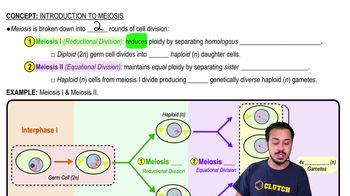
Meiosis is a specialized form of cell division that reduces the chromosome number by half, resulting in four haploid cells from one diploid cell. It consists of two sequential divisions: meiosis I and meiosis II. During meiosis, homologous chromosomes are separated in meiosis I, and sister chromatids are separated in meiosis II, ultimately leading to the formation of gametes.
Recommended video:
Guided course
04:49
Meiosis I & Meiosis II

DNA Content and Cell Cycle Phases

The cell cycle consists of several phases, including G1, S, G2, and M. In the G1 phase, cells have a diploid amount of DNA (2n), which is the normal state before DNA replication. After the S phase, the DNA content doubles (4n) as each chromosome is replicated, but during meiosis, the DNA content is halved again during the first meiotic division.
Recommended video:
Guided course
09:54
Phases of The Krebs Cycle

Meiosis I and DNA Amount

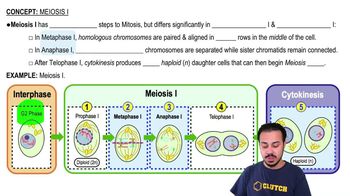
During meiosis I, specifically at the end of prophase I and metaphase I, the cells still contain the diploid amount of DNA (2n) because the DNA has been replicated but not yet separated. Therefore, at this stage, the amount of DNA in the cells undergoing meiosis is equal to that of a G1 phase cell, which also has a diploid DNA content before replication.
Recommended video:
Related Practice
Textbook Question

What proportion of chromosomes in a man's skin cell are maternal chromosomes?

1324
views
Textbook Question

Nondisjunction that leads to problems in offspring can occur in:

a. Mitosis

b. Meiosis I only

c. Meiosis I and II

d. Mitosis, meiosis I, and meiosis II

1342
views
Textbook Question

Select True or False for each statement.

Sister chromatids are homologous chromosomes.

Non-sister chromatids are found on two different homologs.

Crossing over occurs between sister chromatids.

A chiasma forms between two of the four molecules of double-stranded DNA on duplicated homologous chromosomes.

1162
views
Textbook Question

Norway rats have 42 chromosomes in their diploid cells. If such a cell enters meiosis, how many chromosomes and double-helical molecules of DNA will be present in each daughter cell at the end of meiosis II?

a. 21 chromosomes and 21 double-helical DNA molecules

b. 21 chromosomes and 42 double-helical DNA molecules

c. 42 chromosomes and 42 double-helical DNA molecules

d. 42 chromosomes and 84 double-helical DNA molecules

496
views
Textbook Question
Norway rats have 42 chromosomes in their diploid cells. If such a cell enters meiosis, how many chromosomes and double-helical molecules of DNA will be present in each daughter cell at the end of meiosis II?a. 21 chromosomes and 21 double-helical DNA moleculesb. 21 chromosomes and 42 double-helical DNA moleculesc. 42 chromosomes and 42 double-helical DNA moleculesd. 42 chromosomes and 84 double-helical DNA molecules
1308
views
Textbook Question

Triploid (3n) watermelons, which are seedless, are produced by crossing a tetraploid (4n) strain with a diploid (2n) plant. Explain why this mating produces a triploid individual.

1098
views