Pearson+ LogoPearson+ Logo
Ch. 13 - Meiosis
Freeman - Biological Science 7th Edition
Freeman7th EditionBiological ScienceISBN: 9783584863285Not the one you use?Change textbook
Chapter 13, Problem 5

Select True or False for each statement.
Sister chromatids are homologous chromosomes.
Non-sister chromatids are found on two different homologs.
Crossing over occurs between sister chromatids.
A chiasma forms between two of the four molecules of double-stranded DNA on duplicated homologous chromosomes.

Verified step by step guidance
1
Understand the definition of sister chromatids: Sister chromatids are identical copies of a single chromosome, connected by a centromere. They are not homologous chromosomes, which are pairs of chromosomes (one from each parent) that have the same genes but may have different alleles.
Recognize the concept of non-sister chromatids: Non-sister chromatids refer to chromatids from homologous chromosomes. Since homologous chromosomes come from different parents, non-sister chromatids are indeed found on two different homologs.
Learn about crossing over: Crossing over is a process that occurs during meiosis where non-sister chromatids exchange genetic material. This does not occur between sister chromatids, as they are identical and do not need to exchange genetic material.
Understand the formation of a chiasma: A chiasma is the point where two non-sister chromatids exchange genetic material during crossing over. It involves two of the four chromatids present in a pair of homologous chromosomes, each consisting of double-stranded DNA.
Review the statements and apply the concepts: Use the definitions and explanations provided to determine the truth value of each statement based on your understanding of sister chromatids, non-sister chromatids, crossing over, and chiasma formation.

Verified video answer for a similar problem:

This video solution was recommended by our tutors as helpful for the problem above.
Video duration:
1m
Was this helpful?

Key Concepts

Here are the essential concepts you must grasp in order to answer the question correctly.

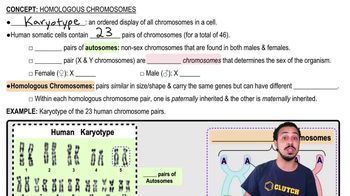
Sister Chromatids vs. Homologous Chromosomes

Sister chromatids are identical copies of a single chromosome, connected by a centromere, formed during DNA replication. In contrast, homologous chromosomes are pairs of chromosomes, one from each parent, that are similar in shape, size, and genetic content but are not identical. Understanding the distinction is crucial for determining relationships between chromatids and chromosomes.
Recommended video:
Guided course
08:09
Homologous Chromosomes

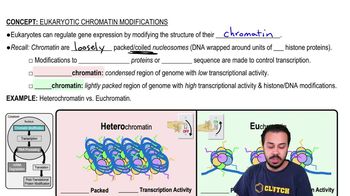
Non-Sister Chromatids

Non-sister chromatids refer to chromatids from homologous chromosomes, which are not identical. They are important in genetic recombination processes like crossing over, where segments of DNA are exchanged between non-sister chromatids, leading to genetic diversity. Recognizing their role helps in understanding genetic variation mechanisms.
Recommended video:
Guided course
03:56
Eukaryotic Chromatin Modifications

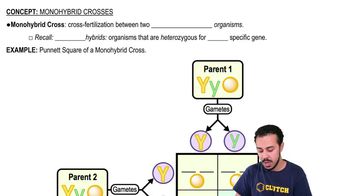
Crossing Over and Chiasma Formation

Crossing over is a process during meiosis where non-sister chromatids exchange genetic material, resulting in genetic recombination. A chiasma is the visible point where this exchange occurs, typically between two of the four chromatids in a homologous pair. This process is essential for genetic diversity and proper segregation of chromosomes during meiosis.
Recommended video:
Guided course
02:05
Monohybrid Crosses
Related Practice
Textbook Question

What is an outcome of genetic recombination?

a. The synapsing of homologs during prophase of meiosis I

b. The new combination of maternal and paternal chromosome segments that results when homologs cross over

c. The new combinations of chromosome segments that result when self-fertilization occurs

d. The combination of a haploid phase and a diploid phase in a life cycle

1082
views
Textbook Question

What proportion of chromosomes in a man's skin cell are maternal chromosomes?

1324
views
Textbook Question

Nondisjunction that leads to problems in offspring can occur in:

a. Mitosis

b. Meiosis I only

c. Meiosis I and II

d. Mitosis, meiosis I, and meiosis II

1342
views
Textbook Question

If you followed a woman's cells through meiosis, at what stage of meiosis would the amount of DNA in one of these cells be equal to the amount of DNA in one of her G1 phase (before DNA replication) kidney cells?

983
views
Textbook Question

Norway rats have 42 chromosomes in their diploid cells. If such a cell enters meiosis, how many chromosomes and double-helical molecules of DNA will be present in each daughter cell at the end of meiosis II?

a. 21 chromosomes and 21 double-helical DNA molecules

b. 21 chromosomes and 42 double-helical DNA molecules

c. 42 chromosomes and 42 double-helical DNA molecules

d. 42 chromosomes and 84 double-helical DNA molecules

496
views
Textbook Question
Norway rats have 42 chromosomes in their diploid cells. If such a cell enters meiosis, how many chromosomes and double-helical molecules of DNA will be present in each daughter cell at the end of meiosis II?a. 21 chromosomes and 21 double-helical DNA moleculesb. 21 chromosomes and 42 double-helical DNA moleculesc. 42 chromosomes and 42 double-helical DNA moleculesd. 42 chromosomes and 84 double-helical DNA molecules
1308
views