
A small portion of the human transport protein amino acid sequence is shown here. The upper sequence is associated with darker skin, and the lower sequence is associated with lighter skin. What DNA base-pair change created the light-skin form of the human protein from the gene that coded for the dark-skin form?
Ch. 16 - How Genes Work
Chapter 16, Problem 15
Biologists have investigated how fast pre-mRNA splicing occurs by treating cells with a toxin that blocks the production of new pre-mRNAs, then following the rate of splicing of the pre-mRNAs that were transcribed before adding the toxin. Why is addition of a toxin important in this study?
Verified step by step guidance1
Identify the purpose of the experiment: The experiment aims to measure the rate of pre-mRNA splicing in cells.
Understand the role of the toxin: The toxin is used to block the production of new pre-mRNAs. This is crucial because it ensures that no new pre-mRNAs are created during the experiment.
Recognize the focus on existing pre-mRNAs: By blocking new pre-mRNA production, researchers can focus solely on the splicing of pre-mRNAs that were already present in the cells at the time the toxin was added.
Analyze the experimental conditions: This setup allows biologists to accurately measure the rate of splicing without interference from the transcription of new pre-mRNAs.
Conclude the importance of the toxin: The addition of the toxin is essential for isolating the variable of interest—pre-mRNA splicing rate—and ensuring that the observed results are due to splicing alone, not confounded by ongoing transcription.

Verified video answer for a similar problem:
This video solution was recommended by our tutors as helpful for the problem above.
Video duration:
1mWas this helpful?
Key Concepts
Here are the essential concepts you must grasp in order to answer the question correctly.
pre-mRNA Splicing
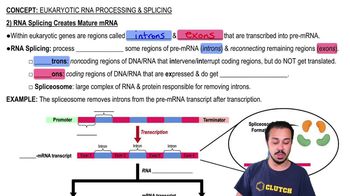
Pre-mRNA splicing is a crucial process in eukaryotic gene expression where introns (non-coding regions) are removed from the pre-mRNA transcript, and exons (coding regions) are joined together. This modification is essential for producing mature mRNA that can be translated into proteins. Understanding the splicing process helps researchers determine how efficiently and quickly genes can be expressed.
Recommended video:
Guided course
2) RNA Splicing Creates Mature mRNA
Toxin's Role in Experimental Design
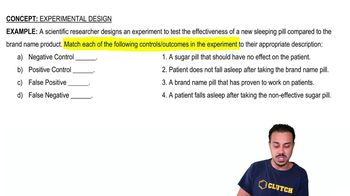
In biological experiments, toxins can be used to inhibit specific cellular processes, allowing researchers to study the effects of these inhibitions. By blocking the production of new pre-mRNAs, the toxin ensures that any observed splicing activity is solely from pre-mRNAs that were already present, providing a clearer picture of the splicing rate and its dynamics under controlled conditions.
Recommended video:
Guided course
Experimental Design Example 1
Rate of Splicing
The rate of splicing refers to how quickly pre-mRNA is processed into mature mRNA. This rate can be influenced by various factors, including the presence of splicing factors and the cellular environment. By measuring the splicing rate after the introduction of a toxin, researchers can gain insights into the efficiency of the splicing machinery and the overall regulation of gene expression.
Recommended video:
Guided course
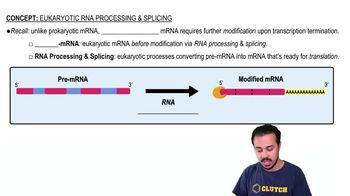
Eukaryotic RNA Processing and Splicing
Related Practice
Textbook Question
801
views
Textbook Question
Researchers compared the amino acid sequences of the transport protein in zebrafish, puffer fish, mice, and humans. They found many stretches with identical sequences in all four species. Does this mean that the corresponding mRNA base sequences are also the same in these four species? Explain why or why not.
1276
views
Textbook Question
The allele of the human transport protein associated with lighter skin is found almost exclusively in people with European ancestry. The other common allele for darker skin, which appears to be the ancestral allele, is found in people with African ancestry. What is a plausible explanation for how the lighter-skin allele came to be so common in those with European ancestry?
874
views
Textbook Question
The primary cause of death from αα-amanitin poisoning is liver failure. Suppose a physician informs you that liver cells die because their rate of protein production falls below a level needed to maintain active metabolism. Given that αα-amanitin is an inhibitor of transcription, you wonder if this information is correct. Propose an experiment to determine whether the toxin also has an effect on protein synthesis.
854
views
