Pearson+ LogoPearson+ Logo
Ch. 16 - How Genes Work
Freeman - Biological Science 7th Edition
Freeman7th EditionBiological ScienceISBN: 9783584863285Not the one you use?Change textbook
Chapter 16, Problem 14

Researchers compared the amino acid sequences of the transport protein in zebrafish, puffer fish, mice, and humans. They found many stretches with identical sequences in all four species. Does this mean that the corresponding mRNA base sequences are also the same in these four species? Explain why or why not.

Verified step by step guidance
1
Identify the relationship between amino acids and mRNA: Amino acids are the building blocks of proteins, and their sequence in a protein is determined by the sequence of nucleotide bases in mRNA through the process of translation.
Understand the genetic code's redundancy: The genetic code is degenerate, meaning that most amino acids are encoded by more than one codon (sequence of three nucleotides in mRNA). This allows for different mRNA sequences to code for the same amino acid.
Consider species-specific codon usage: Different organisms might preferentially use certain codons over others to code for the same amino acid, a phenomenon known as codon bias. This can lead to variations in mRNA sequences across species even when the amino acid sequences are identical.
Examine evolutionary conservation: The presence of identical amino acid sequences in different species suggests that these protein regions are evolutionarily conserved due to their importance in function. However, the underlying mRNA sequences might still differ due to the degeneracy of the genetic code.
Conclude the relationship: While the identical amino acid sequences in the transport proteins of zebrafish, puffer fish, mice, and humans suggest a conserved function, it does not necessarily mean that the mRNA sequences are identical across these species due to the redundancy of the genetic code and species-specific codon preferences.

Verified video answer for a similar problem:

This video solution was recommended by our tutors as helpful for the problem above.
Video duration:
46s
Was this helpful?

Key Concepts

Here are the essential concepts you must grasp in order to answer the question correctly.

Amino Acid Sequences

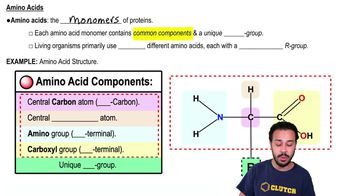
Amino acid sequences are the linear arrangements of amino acids in a protein, determined by the genetic code. These sequences dictate the protein's structure and function. Identical amino acid sequences across different species suggest evolutionary conservation, but do not directly imply that the mRNA sequences are identical.
Recommended video:

mRNA and Genetic Code

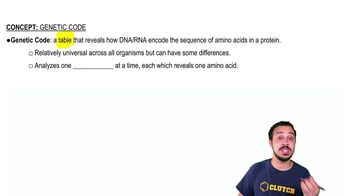
mRNA (messenger RNA) is synthesized from DNA and carries the genetic information necessary for protein synthesis. The genetic code is a set of rules that defines how sequences of nucleotides in mRNA correspond to specific amino acids. While identical amino acid sequences suggest similar mRNA sequences, variations can exist due to differences in codon usage or alternative splicing.
Recommended video:

Evolutionary Conservation

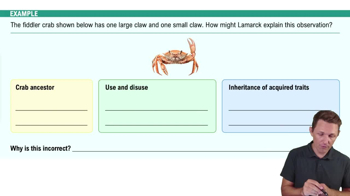
Evolutionary conservation refers to the retention of certain biological traits or sequences across different species due to their functional importance. When researchers find identical sequences in proteins across species, it indicates that these sequences have been preserved through evolution, often because they perform essential roles. However, conservation at the protein level does not guarantee identical mRNA sequences due to potential variations in the underlying DNA.
Recommended video:
02:45
History of Evolutionary Theory Example 1
Related Practice
Textbook Question
Eating even a single death cap mushroom (Amanita phalloides) can be fatal due to a compound called αα-amanitin, a toxin that inhibits transcription.What would you predict to be the immediate outcome of adding αα-amanitin to a cell?a. reduced DNA synthesisb. reduced production of one or more types of RNAc. reduced binding of tRNAs to anticodonsd. reduced rate of translocation of ribosomes translating mRNA
1644
views
Textbook Question

Investigators examined the expression of transporter mRNA and protein produced in zebrafish homozygous for each of the alleles and obtained the results summarized here (+=present,−=absent). Does the allele associated with light color appear to be altering transcription ortranslation? Why?

629
views
Textbook Question

A small portion of the human transport protein amino acid sequence is shown here. The upper sequence is associated with darker skin, and the lower sequence is associated with lighter skin. What DNA base-pair change created the light-skin form of the human protein from the gene that coded for the dark-skin form?

801
views
Textbook Question

The allele of the human transport protein associated with lighter skin is found almost exclusively in people with European ancestry. The other common allele for darker skin, which appears to be the ancestral allele, is found in people with African ancestry. What is a plausible explanation for how the lighter-skin allele came to be so common in those with European ancestry?

874
views
Textbook Question
Biologists have investigated how fast pre-mRNA splicing occurs by treating cells with a toxin that blocks the production of new pre-mRNAs, then following the rate of splicing of the pre-mRNAs that were transcribed before adding the toxin. Why is addition of a toxin important in this study?
931
views
Textbook Question
The primary cause of death from αα-amanitin poisoning is liver failure. Suppose a physician informs you that liver cells die because their rate of protein production falls below a level needed to maintain active metabolism. Given that αα-amanitin is an inhibitor of transcription, you wonder if this information is correct. Propose an experiment to determine whether the toxin also has an effect on protein synthesis.
854
views