Pearson+ LogoPearson+ Logo
Ch. 16 - How Genes Work
Freeman - Biological Science 7th Edition
Freeman7th EditionBiological ScienceISBN: 9783584863285Not the one you use?Change textbook
Chapter 16, Problem 3

DNA's primary structure is made up of just four different bases, and its secondary structure is regular and highly stable. How can a molecule with these characteristics hold the information required to build and maintain a cell?

Verified step by step guidance
1
Understand that DNA's primary structure consists of a sequence of four nucleotide bases: adenine (A), thymine (T), cytosine (C), and guanine (G). These bases are arranged in a specific order along the DNA strand, and this sequence encodes genetic information.
Recognize that the secondary structure of DNA is a double helix, where two complementary strands are held together by hydrogen bonds between specific base pairs: adenine pairs with thymine (A-T) and cytosine pairs with guanine (C-G). This complementary base pairing ensures accurate replication and stability of the genetic information.
Realize that the sequence of bases in DNA acts as a code, where groups of three bases (called codons) correspond to specific amino acids. These amino acids are the building blocks of proteins, which perform essential functions in the cell.
Understand that the information in DNA is transcribed into messenger RNA (mRNA) through a process called transcription. The mRNA then carries this information to ribosomes, where it is translated into proteins during the process of translation.
Appreciate that the stability of DNA's secondary structure ensures the long-term storage of genetic information, while the variability in the sequence of bases allows for the diversity of proteins and cellular functions necessary to build and maintain a cell.

Verified video answer for a similar problem:

This video solution was recommended by our tutors as helpful for the problem above.
Video duration:
47s
Was this helpful?

Key Concepts

Here are the essential concepts you must grasp in order to answer the question correctly.

DNA Structure

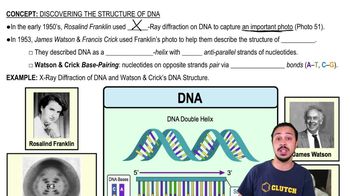
DNA is composed of a backbone made of sugar and phosphate groups, with four nitrogenous bases (adenine, thymine, cytosine, and guanine) attached. The sequence of these bases encodes genetic information, with specific combinations corresponding to different genes. The primary structure refers to the linear sequence of these bases, while the secondary structure describes the double helix formed by base pairing.
Recommended video:
Guided course
04:41
Discovering the Structure of DNA

Base Pairing and Complementarity

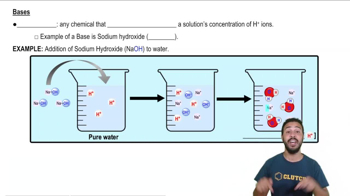
The stability of the DNA double helix arises from specific base pairing: adenine pairs with thymine, and cytosine pairs with guanine. This complementarity ensures accurate replication and transcription of genetic information. The hydrogen bonds between paired bases contribute to the overall stability of the DNA structure, allowing it to maintain its integrity while still being accessible for cellular processes.
Recommended video:

Genetic Code and Protein Synthesis

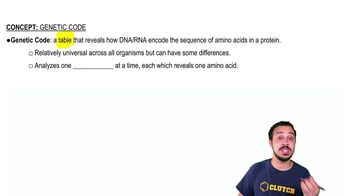
The genetic code is a set of rules that defines how sequences of nucleotide bases in DNA correspond to amino acids in proteins. This code is read in triplets, known as codons, during the processes of transcription and translation. The information encoded in DNA ultimately directs the synthesis of proteins, which are essential for cell structure and function, thereby enabling the cell to build and maintain itself.
Recommended video:
Related Practice
Textbook Question
What does a bacterial RNA polymerase produce when it transcribes a protein-coding gene?a. rRNAb. tRNAc. mRNAd. snRNA
1783
views
Textbook Question
If a base-pair change occurs in DNA, thisa. is a mutation.b. would be a mutation only if it falls in a protein-coding part of a gene.c. would be a mutation only if it falls in a transcribed part of the genome.d. is not a mutation, because only one base pair has been altered.
845
views
Textbook Question

Which of the following is an important exception to the central dogma of molecular biology?

a. Many genes code for RNAs that function directly in the cell.

b. DNA is the repository of genetic information in all cells.

c. Messenger RNA is a short-lived 'information carrier.

d. Proteins are responsible for most aspects of the phenotype.

2510
views
Textbook Question
DNA's primary structure is made up of just four different bases, and its secondary structure is regular and highly stable. How can a molecule with these characteristics hold the information required to build and maintain a cell?
1921
views
Textbook Question

Which of the following describes the experimental strategy that was used to decipher the genetic code?

a. Comparing the amino acid sequences of proteins with the base sequence of their genes

b. Analyzing the sequence of RNAs produced from known DNA sequences

c. Analyzing mutants that changed the code

d. Examining the polypeptides produced when RNAs with particular sequences were translated

837
views
Textbook Question
Which of the following describes the experimental strategy that was used to decipher the genetic code?a. comparing the amino acid sequences of proteins with the base sequence of their genesb. analyzing the sequence of RNAs produced from known DNA sequencesc. analyzing mutants that changed the coded. examining the polypeptides produced when RNAs with particular sequences were translated
1121
views