Pearson+ LogoPearson+ Logo
Ch. 16 - How Genes Work
Freeman - Biological Science 7th Edition
Freeman7th EditionBiological ScienceISBN: 9783584863285Not the one you use?Change textbook
Chapter 16, Problem 11

Eating even a single death cap mushroom (Amanita phalloides) can be fatal due to a compound called αα-amanitin, a toxin that inhibits transcription.What would you predict to be the immediate outcome of adding αα-amanitin to a cell?a. reduced DNA synthesisb. reduced production of one or more types of RNAc. reduced binding of tRNAs to anticodonsd. reduced rate of translocation of ribosomes translating mRNA

Verified step by step guidance
1
Identify the function of α-amanitin: α-amanitin is a toxin known to inhibit transcription.
Understand transcription: Transcription is the process by which the information in a strand of DNA is copied into a new molecule of messenger RNA (mRNA).
Relate the toxin's effect to transcription: Since α-amanitin inhibits transcription, it directly affects the synthesis of RNA.
Analyze the options in relation to transcription inhibition: Determine which of the provided options directly relates to the inhibition of transcription and the subsequent synthesis of RNA.
Conclude the immediate outcome: The immediate outcome of adding α-amanitin would be the option that directly involves the reduction in RNA production due to the inhibition of transcription.

Verified video answer for a similar problem:

This video solution was recommended by our tutors as helpful for the problem above.
Video duration:
1m
Was this helpful?

Key Concepts

Here are the essential concepts you must grasp in order to answer the question correctly.

Transcription

Transcription is the process by which the genetic information in DNA is copied into messenger RNA (mRNA). This process is essential for gene expression, as it allows the information stored in DNA to be translated into proteins. Inhibition of transcription, such as by αα-amanitin, directly affects the production of RNA molecules, leading to reduced gene expression.
Recommended video:
Guided course
04:16
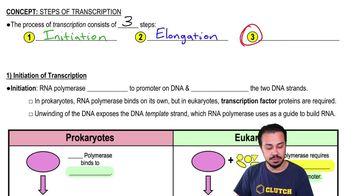
1) Initiation of Transcription

RNA Polymerase

RNA polymerase is the enzyme responsible for synthesizing RNA from a DNA template during transcription. αα-amanitin specifically inhibits RNA polymerase II, which is crucial for mRNA synthesis. When this enzyme is inhibited, the cell cannot produce mRNA, leading to a decrease in the overall production of proteins and other RNA types necessary for cellular function.
Recommended video:
Guided course
05:03
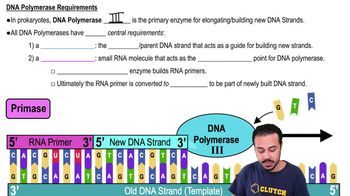
DNA Polymerase Requirements

Toxin Mechanism of Action

The mechanism of action of a toxin refers to how it exerts its harmful effects on biological systems. In the case of αα-amanitin, its ability to inhibit RNA polymerase disrupts the transcription process, leading to a cascade of cellular dysfunction. Understanding this mechanism is vital for predicting the immediate outcomes of toxin exposure, such as reduced RNA production and impaired cellular activities.
Recommended video:
Guided course
09:55
Action Potential
Related Practice
Textbook Question
Controlling the rates of transcription and translation is important in bacteria to avoid collisions between ribosomes and RNA polymerases. Calculate what the maximum rate of translation by a ribosome in a bacterial cell would have to be, in units of amino acids per second, so as not to overtake an RNA polymerase that is synthesizing mRNA at a rate of 60 nucleotides per second. How long would it take for this bacterial cell to translate an mRNA containing 1800 codons?
1746
views
Textbook Question

Skin color is often one of the first traits people notice in each other. Studies in zebrafish uncovered a mutation that altered a transport protein and resulted in light-colored fish. This discovery led to the finding that the same gene in humans has a strong influence on skin pigmentation in many populations. The zebrafish mutation that reduced coloration created a null allele of the transport protein gene. Which of the following types of mutation would be most likely to create this null allele?

a. A missense mutation

b. A frameshift mutation

c. A neutral mutation

d. A silent mutation

597
views
Textbook Question
Skin color is often one of the first traits people notice in each other. Studies in zebrafish uncovered a mutation that altered a transport protein and resulted in light-colored fish. This discovery led to the finding that the same gene in humans has a strong influence on skin pigmentation in many populations. The zebrafish mutation that reduced coloration created a null allele of the transport protein gene. Which of the following types of mutation would be most likely to create this null allele?a. a missense mutationb. a frameshift mutationc. a neutral mutationd. a silent mutation
934
views
Textbook Question

Investigators examined the expression of transporter mRNA and protein produced in zebrafish homozygous for each of the alleles and obtained the results summarized here (+=present,−=absent). Does the allele associated with light color appear to be altering transcription ortranslation? Why?

629
views
Textbook Question

A small portion of the human transport protein amino acid sequence is shown here. The upper sequence is associated with darker skin, and the lower sequence is associated with lighter skin. What DNA base-pair change created the light-skin form of the human protein from the gene that coded for the dark-skin form?

801
views
Textbook Question

Researchers compared the amino acid sequences of the transport protein in zebrafish, puffer fish, mice, and humans. They found many stretches with identical sequences in all four species. Does this mean that the corresponding mRNA base sequences are also the same in these four species? Explain why or why not.

1276
views