Pearson+ LogoPearson+ Logo
Ch. 20 - The Molecular Revolution: Biotechnology, Genomics, and New Frontiers
Freeman - Biological Science 7th Edition
Freeman7th EditionBiological ScienceISBN: 9783584863285Not the one you use?Change textbook
Chapter 20, Problem 8

A friend who works in a research lab performed a GWAS and discovered a tight association between a SNP allele and the disease she is studying. She concluded that the SNP allele must be the mutation that causes the disease. Explain why she is likely to be wrong.

Verified step by step guidance
1
Understand the concept of SNP (Single Nucleotide Polymorphism): SNPs are variations at a single position in DNA among individuals. They are the most common type of genetic variation in humans.
Recognize the nature of GWAS (Genome-Wide Association Studies): GWAS are studies that involve scanning markers across the genomes of many people to find genetic variations associated with a particular disease. However, these studies only show associations and do not prove causation.
Consider Linkage Disequilibrium: SNPs found to be associated with a disease in GWAS may be in linkage disequilibrium with the actual causal mutation. This means the SNP is near the true causal genetic variant and inherited together with it, but is not itself the cause of the disease.
Evaluate the need for further research: To establish causality, further studies such as functional genomics or experimental validation are needed. These studies can help determine if the SNP directly affects the biological pathway of the disease.
Explore alternative explanations: It's also possible that multiple SNPs or a combination of genetic and environmental factors contribute to the disease, rather than a single SNP being the sole cause.

Verified video answer for a similar problem:

This video solution was recommended by our tutors as helpful for the problem above.
Video duration:
3m
Was this helpful?

Key Concepts

Here are the essential concepts you must grasp in order to answer the question correctly.

Genome-Wide Association Studies (GWAS)

GWAS are research methods used to identify genetic variants associated with specific diseases by scanning the genomes of many individuals. They focus on single nucleotide polymorphisms (SNPs) to find correlations between genetic variations and phenotypic traits. However, GWAS can only show associations, not causation, meaning that while a SNP may be linked to a disease, it does not necessarily mean it causes the disease.
Recommended video:
Guided course
05:30
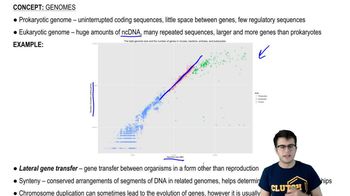
Genomes and Genome Evolution

Causation vs. Correlation

Causation refers to a direct cause-and-effect relationship, while correlation indicates a statistical association between two variables without implying that one causes the other. In the context of GWAS, a SNP may correlate with a disease, but other factors, such as environmental influences or nearby genes, could be responsible for the observed association, leading to potential misinterpretation of the SNP's role.
Recommended video:
Guided course
03:39
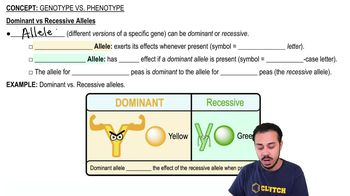
Dominant vs. Recessive Alleles

Genetic Heterogeneity

Genetic heterogeneity occurs when a single phenotype or disease can be caused by different genetic mutations or variations. In diseases, multiple SNPs or other genetic factors may contribute to the same condition, complicating the interpretation of GWAS results. This means that the identified SNP allele may be associated with the disease but not be the sole cause, as other genetic or environmental factors could also play significant roles.
Recommended video:
Guided course
02:19
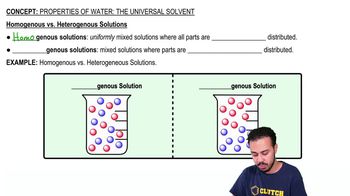
Homogenous vs. Heterogenous Solutions
Related Practice
Textbook Question

Consider the validity of the following statements about genome editing. Select True or False for each statement.

T/FCas proteins work as endonucleases.

T/FsgRNA is used by bacterial cells to detect which DNA to cut.

T/FHomologous recombination is always used to join pieces of broken DNA.

T/FIt is possible to modify genes as well as disrupt them by genome editing.

592
views
Textbook Question

Gene density is the number of genes per million base pairs (Mbp). Using Figure 20.5b, find the approximate number of genes estimated in water fleas and in humans, and note the size of each genome. Calculate the gene density in water fleas relative to that in humans.

1637
views
Textbook Question

A friend who works in a research lab performed a GWAS and discovered a tight association between a SNP allele and the disease she is studying. She concluded that the SNP allele must be the mutation that causes the disease. Explain why she is likely to be wrong.

535
views
Textbook Question

Revolutionaries executed Nicholas II, the last czar of Russia, along with his wife and five children, the family physician, and about a dozen servants. Many decades later, a grave said to hold the remains of the royal family was discovered. Biologists were asked to analyze DNA from the bodies. If the remains of the family were in this grave, predict how similar the DNA fingerprints would be between the parents, the children, and the unrelated individuals in the grave.

650
views
Textbook Question
Revolutionaries executed Nicholas II, the last czar of Russia, along with his wife and five children, the family physician, and about a dozen servants. Many decades later, a grave said to hold the remains of the royal family was discovered. Biologists were asked to analyze DNA from the bodies. If the remains of the family were in this grave, predict how similar the DNA fingerprints would be between the parents, the children, and the unrelated individuals in the grave.
844
views
Textbook Question

One hypothesis for differences between humans and chimpanzees involves differences in gene regulation. A study using RNA-seq showed that the overall patterns of gene expression were similar in the liver and blood of the two species, but the expression patterns were strikingly different in the brain. How do these results relate to the hypothesis?

843
views