
A friend who works in a research lab performed a GWAS and discovered a tight association between a SNP allele and the disease she is studying. She concluded that the SNP allele must be the mutation that causes the disease. Explain why she is likely to be wrong.
Freeman 7th Edition
Ch. 20 - The Molecular Revolution: Biotechnology, Genomics, and New Frontiers
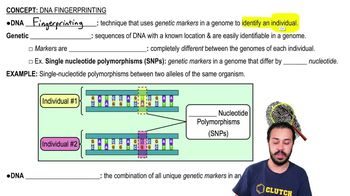
Problem 9Revolutionaries executed Nicholas II, the last czar of Russia, along with his wife and five children, the family physician, and about a dozen servants. Many decades later, a grave said to hold the remains of the royal family was discovered. Biologists were asked to analyze DNA from the bodies. If the remains of the family were in this grave, predict how similar the DNA fingerprints would be between the parents, the children, and the unrelated individuals in the grave.
Verified step by step guidance
Verified video answer for a similar problem:
Key Concepts
DNA Fingerprinting
Inheritance Patterns
Genetic Relatedness
Revolutionaries executed Nicholas II, the last czar of Russia, along with his wife and five children, the family physician, and about a dozen servants. Many decades later, a grave said to hold the remains of the royal family was discovered. Biologists were asked to analyze DNA from the bodies. If the remains of the family were in this grave, predict how similar the DNA fingerprints would be between the parents, the children, and the unrelated individuals in the grave.
One hypothesis for differences between humans and chimpanzees involves differences in gene regulation. A study using RNA-seq showed that the overall patterns of gene expression were similar in the liver and blood of the two species, but the expression patterns were strikingly different in the brain. How do these results relate to the hypothesis?
Potato blight causes potato plants to shrivel and rot. The disease is caused by the pathogen Phytophthora infestans, infamous for its role in Ireland's Great Potato Famine in the mid-1840s. The disease can devastate crops during wet weather, sometimes leading to total crop loss. Researchers aim to use recombinant DNA methods to transfer blight resistance genes from resistant varieties into susceptible varieties of potato. Explain how restriction endonucleases and DNA ligase could be used to insert a potato blight resistance gene into a plasmid.