
Pearson+ LogoPearson+ Logo
Ch. 20 - The Molecular Revolution: Biotechnology, Genomics, and New Frontiers
Freeman - Biological Science 7th Edition
Freeman7th EditionBiological ScienceISBN: 9783584863285Not the one you use?Change textbook
Chapter 20, Problem 7

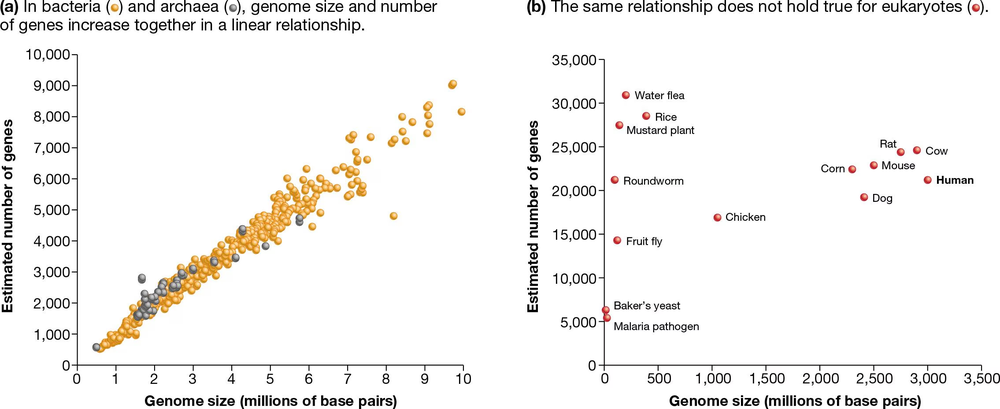
Gene density is the number of genes per million base pairs (Mbp). Using Figure 20.5b, find the approximate number of genes estimated in water fleas and in humans, and note the size of each genome. Calculate the gene density in water fleas relative to that in humans.
Scatter plot showing genome size vs. estimated gene count for eukaryotes, highlighting water flea and human data points.

Verified step by step guidance
1
Step 1: First, you need to identify the number of genes and the size of the genome in both water fleas and humans from Figure 20.5b. The number of genes is usually given in thousands and the size of the genome in million base pairs (Mbp).
Step 2: Next, calculate the gene density for each organism. Gene density is calculated by dividing the number of genes by the size of the genome (in Mbp). So, if for example, water fleas have 31,000 genes and a genome size of 200 Mbp, the gene density would be 31,000/200 = 155 genes/Mbp.
Step 3: Similarly, calculate the gene density for humans. If humans have 20,500 genes and a genome size of 3,200 Mbp, the gene density would be 20,500/3,200 = 6.4 genes/Mbp.
Step 4: To find the gene density of water fleas relative to that in humans, divide the gene density of water fleas by the gene density of humans. Using the example numbers, this would be 155/6.4 = 24.2.
Step 5: Interpret your results. In this example, the gene density in water fleas is approximately 24 times greater than that in humans. This means that there are more genes per million base pairs in the genome of water fleas compared to humans.

Verified video answer for a similar problem:

This video solution was recommended by our tutors as helpful for the problem above.
Video duration:
1m
Was this helpful?

Key Concepts

Here are the essential concepts you must grasp in order to answer the question correctly.

Gene Density

Gene density refers to the number of genes present per million base pairs (Mbp) in a genome. It provides insight into how densely packed genes are within the DNA, which can vary significantly between different organisms. Understanding gene density helps in comparing the complexity and functionality of genomes across species.
Recommended video:
Guided course
05:43
Density of Liquid Water vs. Solid Ice

Genome Size

Genome size is the total amount of DNA contained within one copy of a genome, usually measured in base pairs or megabase pairs (Mbp). It is a crucial factor in determining gene density, as larger genomes may have more non-coding regions, affecting the number of genes per unit of DNA. Comparing genome sizes helps in understanding evolutionary and functional differences between species.
Recommended video:
Guided course
05:30
Genomes and Genome Evolution

Comparative Genomics

Comparative genomics involves analyzing and comparing the genomes of different species to understand their evolutionary relationships and functional differences. By comparing gene density and genome size, researchers can infer how genetic complexity and organization vary among organisms, providing insights into their biology and adaptation strategies.
Recommended video:
Guided course
05:30
Genomes and Genome Evolution
Related Practice
Textbook Question

The human genome size is 3 billion base pairs, and the size of the baker's yeast genome, a single-celled organism, is 12 million base pairs. Therefore, the predicted genome size for another single-celled organism, an amoeba,

a. Is about the size of the human genome

b. Is about the size of the yeast genome

c. Is somewhere between the sizes of the yeast and human genomes

d. Cannot be predicted with any certainty

1310
views
Textbook Question

Explain how RNA-seq can be used to analyze patterns of gene expression.

861
views
Textbook Question

Consider the validity of the following statements about genome editing. Select True or False for each statement.

T/FCas proteins work as endonucleases.

T/FsgRNA is used by bacterial cells to detect which DNA to cut.

T/FHomologous recombination is always used to join pieces of broken DNA.

T/FIt is possible to modify genes as well as disrupt them by genome editing.

592
views
Textbook Question

A friend who works in a research lab performed a GWAS and discovered a tight association between a SNP allele and the disease she is studying. She concluded that the SNP allele must be the mutation that causes the disease. Explain why she is likely to be wrong.

535
views
Textbook Question
A friend who works in a research lab performed a GWAS and discovered a tight association between a SNP allele and the disease she is studying. She concluded that the SNP allele must be the mutation that causes the disease. Explain why she is likely to be wrong.
682
views
Textbook Question

Revolutionaries executed Nicholas II, the last czar of Russia, along with his wife and five children, the family physician, and about a dozen servants. Many decades later, a grave said to hold the remains of the royal family was discovered. Biologists were asked to analyze DNA from the bodies. If the remains of the family were in this grave, predict how similar the DNA fingerprints would be between the parents, the children, and the unrelated individuals in the grave.

650
views